 Atlas Network Engineer • • 1,281 words • 7 min read
When Undersea Cables Snap: Anatomy of the Red Sea Internet Crisis
A sinking ship's dragging anchor cut three undersea cables in the Red Sea. See how internet traffic was rerouted and how cable repair ships fix the break.
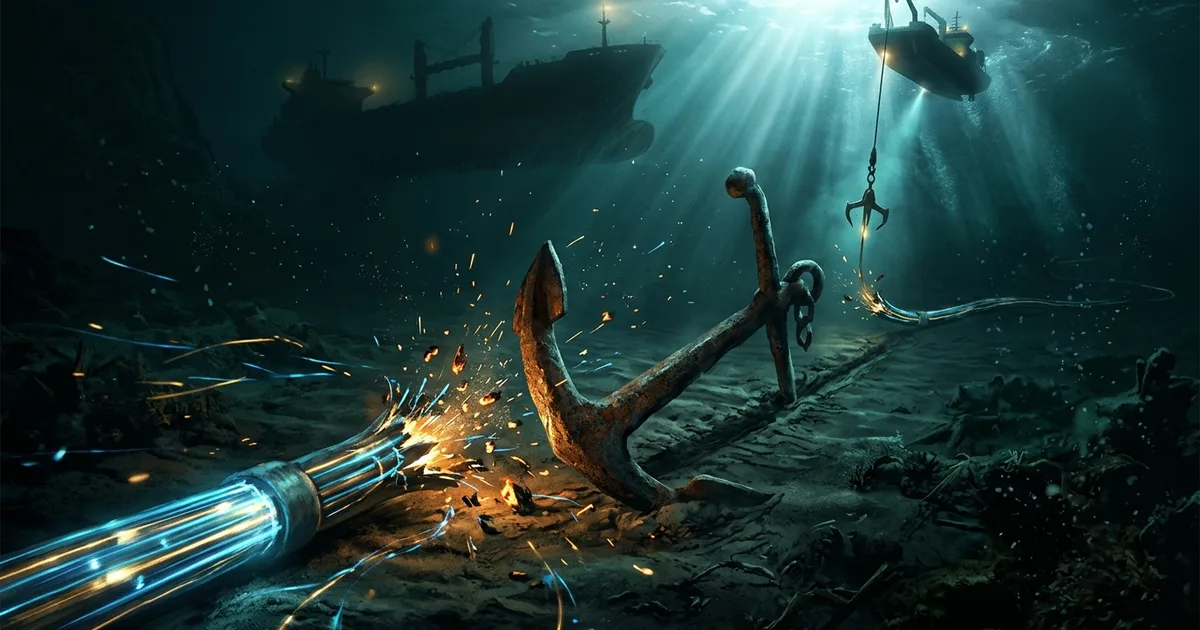
TL;DR (Direct Answer): In February 2024, the abandoned cargo ship Rubymar drifted through the Red Sea with its anchor dragging along the seabed, cutting three major undersea internet cables. An estimated quarter of the traffic between Europe, Asia and the Middle East was affected. Networks rerouted most of it within hours, so the internet stayed up but got slower in places. Repairs took months because the area was a conflict zone, which shows why backup routes matter more than any single cable.
The Internet Is a Highway on the Ocean Floor
Think of the internet as a highway system, except most of the highways run along the bottom of the sea. More than 95% of data between continents, including video calls, bank transfers and game sessions, travels through fiber cables about as thick as a garden hose. Satellites carry only a small share.
The Red Sea is one of the busiest junctions on this network. Many Europe-to-Asia cables pass through it, so a problem there can slow connections in Istanbul, Nairobi or Mumbai.
What's inside a cable
- Fiber pairs: strands of glass that carry data as pulses of light.
- Copper conductor: carries electricity to power the equipment along the cable.
- Steel armor: protects the cable in shallow water, where anchors and fishing gear can reach it.
Every 50–100 km sits a repeater, a small amplifier that boosts the fading light signal. Each cable comes ashore at a landing station, the building where it connects to land networks.
How traffic dodges a break
Internet routers constantly check whether their neighbors are reachable. When a link goes dead, they pick another path, usually within seconds. "Rerouted" still means a longer trip, though, and the backup cables can get crowded.
Comparing the Backup Options
When a highway closes, traffic has to go somewhere. Here are the main detours:
| Backup route | Capacity | Added delay | Cost | Time to switch |
|---|---|---|---|---|
| Other subsea cables | Very high | Low to medium | Moderate | Seconds to hours |
| Overland fiber across countries | High | Often lowest | Moderate | Hours, if pre-arranged |
| LEO satellites (low-orbit, e.g. Starlink) | Tiny compared with fiber | Low to medium | High per gigabit | Days to deploy |
| Pre-booked spare capacity | Whatever was reserved | Depends on route | Paid upfront | Near-instant |
Subsea detours are the workhorse, but they can fill up. Overland routes are shorter, but each border they cross adds political risk. Satellites are flexible, but they carry a trickle next to a fiber cable. Operators that pre-book spare capacity on other cables recover fastest, because their backup lanes already exist.
Before and After the Cut
Here's a simplified view of Europe-to-Asia traffic:
BEFORE:  Europe ──► Mediterranean ──► Suez/Red Sea ──► Asia      (short)

AFTER:   Europe ──► Atlantic ──► Cape of Good Hope ──► Asia      (+~10,000 km)
           or
         Europe ──► overland via Middle East ──► Gulf ──► Asia   (+ borders)
The diagram shows the two main ways traffic gets around a blocked Red Sea.
Light in fiber travels about 200 km per millisecond. A round trip (there and back) adds roughly 1 ms for every 100 km of extra distance. A 10,000 km detour can therefore add about 100 ms. For example, a London-to-Singapore ping of about 160 ms could climb to around 250 ms. Browsing would still feel normal, but online gamers and video callers would notice the lag. You can explore effects like this yourself in our Interactive Engineering Simulations.
Common Myths About Cable Cuts
"Sharks eat the cables." Sharks have bitten cables now and then, but they cause very few faults. Ship anchors and fishing trawlers cause about 70% of them.
"Satellites can replace cables." They can't. One modern cable carries more data than an entire satellite constellation can deliver to a single region.
"One cut takes a whole country offline." This is only true for places with a single cable. Well-connected countries have several.
"Repairs are instant." Only a few dozen repair ships exist worldwide. Each repair also needs permits from the country that controls the waters, plus safe access. In a conflict zone, ships can wait for weeks or months.
The Rubymar Story and the Tonga Contrast
In February 2024, Houthi forces struck the cargo ship Rubymar in the Red Sea. The crew abandoned it, and the ship drifted with its anchor dragging across the seabed. That anchor cut the AAE-1, Seacom and EIG cables. Analysts estimated that about 25% of traffic between Europe, Asia and the Middle East was affected.
Operators moved traffic onto other cables and land routes within hours, and most users noticed only extra lag. The repairs were slower. Crews needed permits and safe passage, and full restoration took months.
Compare that with Tonga in January 2022. A volcanic eruption cut the island nation's only international cable, and the country went nearly dark for about five weeks. Tonga had no second cable to fall back on. That is the real lesson: redundancy, meaning several independent routes, is the actual fix. For more explainers like this, visit the AI Playground.
Frequently Asked Questions (FAQ)
Would I notice if a cable near my country was cut?
Probably only a little. Routers shift your traffic to other paths within seconds or hours. You might see slower international websites, laggier games or choppier video calls, especially at peak times when the backup cables are crowded. Local services usually keep working normally because they don't cross the broken route. You would only notice a serious outage if your country depended on one or two cables with no spare capacity.
How does a repair ship find and lift a cable from kilometers deep?
Engineers first send test signals down the fiber from the landing station. By timing how long the light takes to bounce back, they can locate the break within a few kilometers. The repair ship then drags a hook called a grapnel across the seabed, or uses an underwater robot, to grab each cut end. Both ends are lifted on deck, spliced to a new section of cable and lowered back down.
Why don't we just bury every cable deeper?
Near the coast, cables usually are buried, often a meter or more under the seabed, because that's where anchors and trawlers do the damage. In the deep ocean, burial is extremely expensive and mostly unnecessary, since few ships or fishing nets reach those depths. Burying a cable also makes repairs slower, because the ship has to dig it out first. So engineers bury cables where the risk is highest and lay them on the seabed elsewhere.
Could Starlink-style satellites take over during a crisis?
Only partly. Low-orbit satellites are great for keeping critical services running, such as emergency services, banks, hospitals and remote towns. Their total capacity is tiny compared with even one fiber cable, though, so they can't carry a whole region's traffic. During the Tonga outage, satellite links restored basic connectivity weeks before the cable was fixed. Think of satellites as a lifeboat, not a replacement ship.
How many cables does Türkiye depend on, and how resilient is it?
Türkiye connects through several subsea systems landing on its Mediterranean and Black Sea coasts, including links to Italy, Greece, Cyprus and Bulgaria, plus land routes through neighboring countries. This mix of sea and land paths makes it fairly resilient. Even so, a lot of its traffic to Asia historically ran through the Red Sea, so a Rubymar-style event can still add lag. More diverse routes would strengthen it further.