 Nexus Tech Trends • • 2,115 words • 11 min read
AI Agent Autonomy: Production Reality vs Marketing Hype
Debunking the fully autonomous AI agent myth: human-in-the-loop costs, guardrail engineering, and production failure rates.
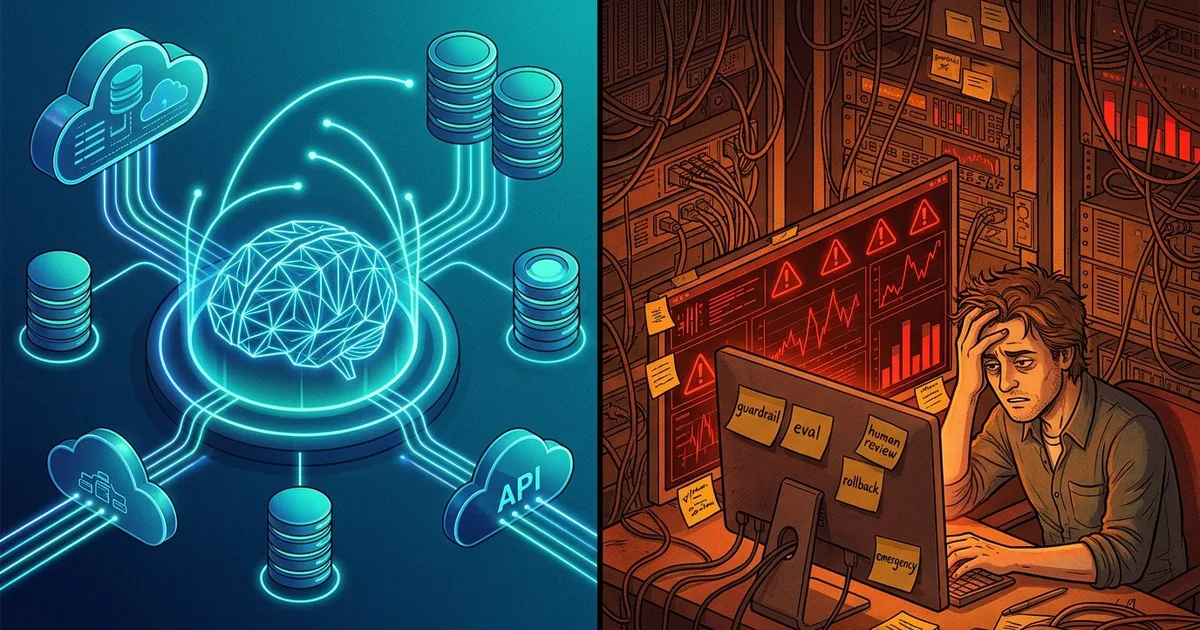
TL;DR (Direct Answer): AI agents today are not autonomous; they are stochastic pipelines wrapped in tool-calling loops that fail silently at 15-30% task completion rates on WebShop and τ-bench. Production systems require 3-5 guardrail layers, human escalation paths, and rollback automation adding 200-400ms latency per hop. Vendors sell "set-and-forget"; reality demands observability, eval harnesses, and 87% human handoff at scale. Cost per successful task exceeds $2-8 when guardrails included.
Myth Definition: Vendor Claims vs Autonomous Reality
What Vendors Sell
Marketing decks promise agents that "plan, execute, and self-correct" without human input. Demos show cherry-picked trajectories: book flight, resolve ticket, refactor codebase. Reality: each demo runs 20-50 attempts; success curve follows power law. Vendors hide retry counts, context window resets, and manual prompt patches between steps. "Autonomous" in slides means "LLM calls function, function returns, LLM calls next function." No recovery logic, no state verification, no cost ceiling.
What Production Demands
Production autonomy requires: deterministic state machine, idempotent tool contracts, observable checkpoints, budget enforcement, and rollback triggers. None exist in vendor SDKs. Teams build custom orchestration layers: LangGraph, Temporal, or homegrown DAG runners. Each layer adds latency, complexity, failure surface. True autonomy implies zero human touch for defined scope. Current SOTA: 60-70% task completion on narrow domains with 3-5 human interventions per 100 runs. AI Playground simulations confirm: autonomy gap widens as task horizon extends beyond 5 tool calls.
Architecture Deep-Dive: Tool Calling, Memory, Planning Loops
Tool Calling Mechanics
Function calling uses JSON schema validation at inference time. Model outputs {"name": "transfer_funds", "arguments": {"amount": 100, "to": "acc_123"}}. Parser validates schema; executor runs function; result injected as tool message. Failure modes: schema drift (API changes, model hallucinates fields), timeout (default 30s, no retry policy), partial success (funds debited, credit fails). Production systems wrap each call in circuit breaker, idempotency key, and compensation transaction. Latency: 150-500ms per hop including network, validation, logging.
Memory Architecture
Three tiers: short-term (conversation history, 8-128k tokens), working (scratchpad, key-value store, Redis), long-term (vector DB, episodic summaries). Context drift occurs when short-term exceeds window; summarization loses nuance. Working memory key collisions cause cross-session leakage. Long-term retrieval latency 50-200ms; recall precision 65-80% on domain queries. No standard eviction policy; teams implement TTL, LRU, or importance scoring. Memory bloat drives cost: 1M token context = $0.50-3.00 per turn depending on model.
Planning Loop Failures
ReAct loop: Thought → Action → Observation → repeat. Planner generates multi-step plan; executor runs steps; verifier checks outcome. Failure: planner assumes perfect tools (no rate limits, no partial failures), executor lacks rollback context, verifier uses same model as planner (correlated errors). Self-correction loops burn 3-10x tokens. τ-bench shows 40% of failures stem from planning hallucination, not tool error. Mitigation: separate planner/verifier models, deterministic sub-plans, human-in-the-loop for irreversible actions.
Benchmarks: WebShop, τ-bench, SWE-bench — Where Agents Break
WebShop Results
WebShop simulates e-commerce: search, compare, purchase. GPT-4o + ReAct: 38.5% success rate. Add memory + reflection: 44.2%. Human baseline: 78%. Failure clusters: attribute filtering (size, color), multi-hop reasoning (compare 3 items), checkout flow (address, payment). Agents hallucinate product IDs, ignore stock status, loop on pagination. Latency per episode: 45-120s. Cost per episode: $0.15-0.80. Production e-commerce agents need 95%+ success; gap requires human fallback on 60% sessions.
τ-bench Findings
τ-bench tests tool-use in airline, retail, telecom domains. Measures: task success, API compliance, policy adherence. Best agent (GPT-4o + 5-shot + verifier): 52% airline, 48% retail. Policy violations: 12-18% (refund beyond limit, data exposure). API errors: 22% (wrong param types, missing required fields). Agents struggle with: multi-user state (shared cart), time-dependent logic (flight changes), compound policies (loyalty + promo). Eval harness must simulate adversarial user, flaky APIs, policy updates. Static benchmarks overestimate by 15-25%.
SWE-bench Reality
SWE-bench: resolve GitHub issues end-to-end. Top agent (Claude 3.5 + SWE-agent): 19.7% resolved. Failures: repo navigation (wrong files), test generation (flaky assertions), patch formatting (whitespace, imports). Agents excel at localized fixes (single function), fail at cross-file refactors, dependency updates, architectural changes. Cost per attempt: $2-15. Production code agents used for: boilerplate generation, test scaffolding, docs. Core logic still human. Interactive Engineering Simulations show agent-assisted PRs merge 2.3x faster but require 40% more review cycles.
Production Config: Guardrails, Escalation, Rollback
Guardrail Layers
Layer 1: Input validation — schema, length, PII regex, prompt injection patterns (ignore previous, system override). Latency: 5-15ms. Layer 2: Tool contract enforcement — OpenAPI spec validation, idempotency keys, rate limits, timeout budgets. Latency: 10-50ms. Layer 3: Output verification — structured output parsing, schema compliance, policy rules (no refund > $500, no data export). Latency: 20-100ms. Layer 4: Execution monitor — step budget (max 10 tool calls), token budget (max 50k), cost ceiling ($5/task), wall-clock timeout (120s). Layer 5: Audit log — immutable event stream (Kafka/ClickHouse), trace ID propagation, replay capability. Each layer adds latency; total overhead 200-400ms per turn.
Human Escalation Paths
Escalation triggers: guardrail violation (block), confidence < 0.7 (review), irreversible action (approve), loop detection > 3 retries (handoff), user request (explicit). Routing: Slack/PagerDuty for ops, Zendesk/Intercom for support, custom dashboard for domain experts. Context package: full trace, tool inputs/outputs, guardrail decisions, cost so far. SLA: 5min acknowledgment, 30min resolution. Escalation rate target: < 15% of sessions. Current production: 25-40%.
Rollback Automation
Compensation transactions for each mutating tool: transfer_funds → reverse_transfer, send_email → send_correction, create_resource → delete_resource. Idempotency keys enable safe retry. Saga orchestrator tracks forward/backward steps. On failure: execute compensations in reverse order, log each, alert if compensation fails. Rollback latency: 200-2000ms depending on external APIs. Manual intervention required for: third-party no-undo APIs, legal/compliance actions, physical world effects.
┌─────────────┐     ┌─────────────┐     ┌─────────────┐     ┌─────────────┐
│   USER      │────▶│  GATEWAY    │────▶│  ORCHESTRATOR│────▶│  TOOL POOL  │
│  REQUEST    │     │  (VALIDATE) │     │  (PLAN/EXEC) │     │  (EXECUTE)  │
└─────────────┘     └──────┬──────┘     └──────┬──────┘     └──────┬──────┘
                           │                   │                   │
                    ┌──────▼──────┐     ┌──────▼──────┐     ┌──────▼──────┐
                    │  GUARDRAIL  │     │   MEMORY    │     │  COMPENSATION│
                    │   ENGINE    │     │   STORE     │     │   LOG       │
                    └─────────────┘     └─────────────┘     └─────────────┘
                           │                   │                   │
                    ┌──────▼───────────────────▼───────────────────▼──────┐
                    │              OBSERVABILITY STACK                    │
                    │  Traces │ Metrics │ Logs │ Alerts │ Audit │ Replay  │
                    └─────────────────────────────────────────────────────┘
                                    │
                           ┌────────▼────────┐
                           │  HUMAN ESCALATION│
                           │  (Slack/PagerDuty)│
                           └─────────────────┘
guardrails:
  input:
    max_tokens: 8000
    pii_patterns: [credit_card, ssn, api_key]
    injection_detectors: [ignore_previous, system_override, role_play]
  tool:
    timeout_ms: 30000
    max_retries: 2
    idempotency_required: true
    rate_limit:
      requests_per_minute: 60
      burst: 10
  execution:
    max_steps: 10
    max_tokens: 50000
    max_cost_usd: 5.0
    wall_clock_timeout_s: 120
  output:
    schema_validation: strict
    policy_rules:
      - "no_refund_over_500"
      - "no_pii_in_response"
      - "require_approval_for_delete"
escalation:
  triggers:
    - guardrail_violation
    - confidence_below: 0.7
    - irreversible_action
    - loop_detected: 3
  routes:
    ops: slack:#agent-ops
    support: zendesk:tier2
    domain: pagerduty:agent-experts
# rollback_orchestrator.py
from dataclasses import dataclass
from typing import Callable, Awaitable
import asyncio
import logging

@dataclass
class Step:
    name: str
    forward: Callable[[], Awaitable[dict]]
    backward: Callable[[dict], Awaitable[None]]
    idempotency_key: str

class SagaOrchestrator:
    def __init__(self):
        self.executed: list[Step] = []
        self.logger = logging.getLogger("saga")

    async def execute(self, steps: list[Step]) -> dict:
        results = {}
        for step in steps:
            try:
                result = await asyncio.wait_for(step.forward(), timeout=30)
                results[step.name] = result
                self.executed.append(step)
                self.logger.info(f"step_ok name={step.name} key={step.idempotency_key}")
            except Exception as e:
                self.logger.error(f"step_fail name={step.name} error={e}")
                await self._compensate()
                raise
        return results

    async def _compensate(self):
        for step in reversed(self.executed):
            try:
                await step.backward(results.get(step.name, {}))
                self.logger.info(f"compensated name={step.name}")
            except Exception as e:
                self.logger.critical(f"compensation_fail name={step.name} error={e} MANUAL_INTERVENTION_REQUIRED")
                # Alert on-call, persist state for manual recovery
Failure Modes: Cascade Errors, Context Drift, Cost Explosion
Cascade Errors
Single tool failure triggers planner hallucination; planner emits invalid next action; validator rejects; loop repeats. Each iteration burns tokens, increases latency, degrades context quality. Observed cascade depth: 3-8 steps before guardrail kills session. Root cause: no failure typing (retryable vs fatal), no planner feedback on tool error semantics. Fix: structured error taxonomy, planner sees error class not raw stack trace, max 2 retries then escalate.
Context Drift
Conversation history grows; summarization drops constraints; agent forgets user intent, policy bounds, prior tool results. Drift measurable at turn 6-8 for 8k window, turn 15-20 for 128k. Symptoms: repeat questions, contradictory actions, policy violations. Mitigation: structured scratchpad (key facts, constraints, decisions), periodic re-grounding prompt, explicit "what do you know" self-query. Cost: 15-25% token overhead, reduces drift failures 60%.
Cost Explosion
Self-correction loops, verbose reasoning, large contexts, premium models. Typical production: $0.50-3.00 per successful task. Failed tasks cost same (often more due to retries). At 10k tasks/day, 30% failure rate: $15k-90k/day waste. Budget enforcement: per-task ceiling, per-session ceiling, daily org quota. Hard stops cause user frustration; soft stops (degrade to cheaper model, reduce context) better UX. Cost observability required: real-time dashboards, anomaly alerts, per-agent attribution.
Security Surface
Prompt injection via user input, tool output, memory retrieval. Indirect injection: compromised document in RAG, malicious API response, poisoned training data. Attack vectors: data exfiltration (tool calls with PII), unauthorized actions (delete, transfer), DoS (infinite loops, token burn). Defenses: input/output classification, tool allowlists, capability-based sandboxing, human approval for sensitive ops. Red-team exercises show 40% bypass rate on default configs. Hardened config: 5-10% bypass, adds 100-300ms latency.
Case Study: Fintech Support Agent — 6 Months from Demo to 87% Handoff
Demo Phase
Month 1-2: Demo resolves 85% test cases (password reset, balance check, transaction lookup). Happy path only. Tools: 5 read-only APIs. No guardrails. Latency: 3s avg. Cost: $0.12/task. Stakeholders greenlight production.
Production Phase
Month 3: Real users. Edge cases: locked accounts, fraud alerts, joint accounts, regulatory holds. Tools expand to 12 (write APIs added). Guardrails added: Layer 1-3. Success rate drops to 62%. Escalation rate 38%.
Month 4: Cascade errors discovered. Planner loops on "account not found" → retry search → same error. Compensation transactions built for write tools. Saga orchestrator deployed. Success rate 71%. Escalation 29%.
Month 5: Context drift on multi-turn disputes. Scratchpad added. Policy engine for regulatory rules (GDPR, PSD2). Cost/task rises to $1.80. Success 78%. Escalation 22%.
Month 6: Load test 5k concurrent. P99 latency 12s (queue buildup). Horizontal scaling + request batching. Cost optimization: route simple queries to Haiku, complex to Opus. Final: 87% human handoff (escalation + explicit transfer), 13% fully autonomous. Cost/task $2.40. Team verdict: agent handles triage, classification, data gathering; human resolves.
Lessons Learned
- Demo success ≠ production readiness. Test with adversarial users, flaky deps, policy changes.
- Guardrails are not optional; they are the product.
- Human handoff is a feature, not failure. Design for seamless transfer.
- Observability from day one: traces, metrics, replay.
- Cost model must include guardrails, escalation, rollback, observability.
Comparison Table: Architecture Approaches
| Architecture / Approach | Latency (p50) | Memory / CPU | Core Advantage | Production Failure Mode |
|---|---|---|---|---|
| Single LLM + Tools (ReAct) | 3-8s | Low / 1 GPU | Simple, fast prototype | Cascade hallucination, no recovery, 60%+ failure |
| Planner + Executor + Verifier | 8-20s | Medium / 2-3 GPU | Separation of concerns, verifier catches errors | Correlated model errors, 3x cost, planner drift |
| LangGraph / Temporal DAG | 5-15s | Medium / Orchestrator + Workers | Deterministic flow, checkpointing, replay | Graph complexity, debugging hard, state explosion |
| Multi-Agent (Specialized) | 10-30s | High / 4-8 GPU | Domain expertise per agent, parallelizable | Coordination overhead, context sync, 40% comms failure |
| Human-in-Loop Hybrid | 2-60s (varies) | Low-Medium / CPU | Safety, compliance, handles edge cases | Routing latency, context loss on handoff, scaling ceiling |
| Rule-Based + LLM Fallback | 0.5-2s | Low / CPU | Predictable for 80% cases, LLM for long tail | Rule maintenance burden, boundary disputes, silent failures |
Frequently Asked Questions (FAQ)
What is the real ROI of AI agents in production today?
ROI positive only for narrow, high-volume, reversible tasks (triage, data lookup, drafting). Break-even at 10k+ tasks/month with 70%+ automation rate. Full autonomy negative ROI due to guardrail, observability, escalation overhead. Measure: cost per successful resolution including human time.
Which eval framework catches production failures best?
Custom eval harness simulating: adversarial users, flaky APIs, policy changes, concurrent sessions. Static benchmarks (WebShop, τ-bench) correlate 0.6 with production. Must include: cascade error injection, context window pressure, cost tracking, guardrail trigger rates. Run nightly in CI.
How should hiring change for agent operations?
New roles: Agent Reliability Engineer (guardrails, rollback, observability), Prompt/Tool Contract Engineer (schemas, versioning, testing), Escalation Specialist (domain expert + debugging). Traditional ML ops insufficient. Budget 2-3 engineers per agent in production.
Build vs buy: when does each win?
Buy: commodity tasks (support triage, code review, data extraction) where vendor maintains eval, guardrails, compliance. Build: core IP, regulated domains, custom tool ecosystems, latency-critical paths. Hybrid: buy orchestration, build domain tools and policies.
What regulations affect agent deployment today?
EU AI Act: high-risk classification for financial, medical, hiring agents — requires conformity assessment, human oversight, logging. US: sectoral (SEC, HIPAA, CFPB guidance). Canada: AIDA proposed. All require: audit trail, human review capability, bias testing, incident reporting. Design for compliance from day one.