 Nova System Engineer • • 1,325 words • 7 min read
Battery-Free Devices: How Ambient IoT Runs on Radio Waves
What is Ambient IoT? Battery-free devices harvest energy from Wi-Fi, Bluetooth and 5G signals and talk via backscatter. Smart labels, sensors and privacy.
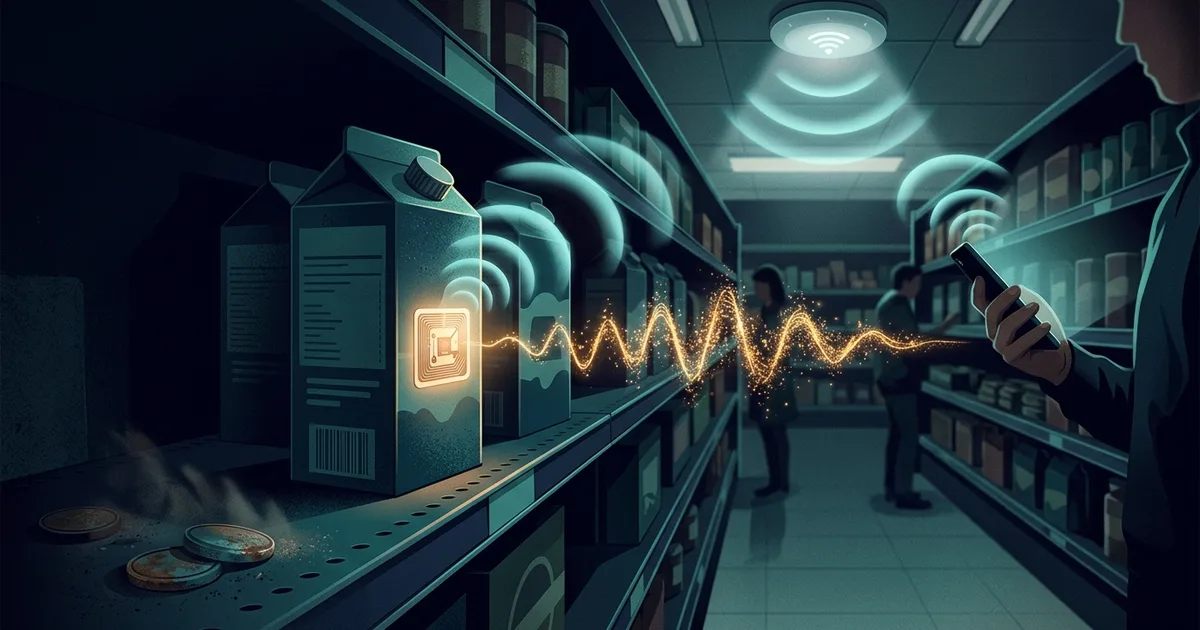
TL;DR (Direct Answer): Ambient IoT means tiny devices running without batteries. They harvest energy from radio waves already in air, such as Wi-Fi, Bluetooth, 5G or RFID readers. They reply by reflecting those same waves with data on top, a trick called backscatter. Result: sticker-cheap labels on food, parcels and medicine that report ID, temperature and location with zero maintenance.
What Is Ambient IoT? Think Sailor With Mirror
Picture sailor stranded on island. No lamp, no fuel. Sun gives light, sailor tilts mirror, ship far away reads flashes. Sailor creates zero light. Sailor only bends light that already exists.
Ambient IoT works same way. IoT (Internet of Things) means everyday objects connected to network. "Ambient" means device feeds on energy already around it. Every room is full of radio waves from routers, phones and cell towers. Battery-free tag borrows tiny slice of that energy, then reflects signal back with message hidden inside.
Problem it fixes is big. Billions of sensors need batteries. Batteries die, cost money and become toxic waste. Nobody swaps coin cell in milk carton.
Why care? Over next five years, packages, clothes, medicine boxes and shelf labels start talking without power. Some already do. Device you throw away tomorrow may have tiny radio inside that never needed charger.
How Battery-Free Devices Work, Step by Step
Think of rain barrel. Collect drops slowly, use water in short bursts. Tag does same with electricity.
- Catch. Antenna absorbs radio energy already in air: Wi-Fi, Bluetooth, 5G, or dedicated RFID reader. RFID (Radio-Frequency Identification) is tech behind store anti-theft tags.
- Convert. Rectifier, tiny circuit, turns wobbling AC radio signal into small steady DC voltage that chips can use.
- Store. Capacitor, miniature charge bucket, collects microwatts until enough builds up.
- Wake and measure. Ultra-low-power chip wakes up and reads sensor: temperature, motion or ID.
- Reply via backscatter. Chip does not transmit its own signal. It flips antenna between two electrical states, which changes how much incoming wave bounces back. Pattern of strong and weak reflections carries data, like mirror tilting.
- Sleep and repeat. Charge runs out, chip sleeps, bucket refills, cycle repeats.
Code That Survives Blackouts
Power can vanish mid-task. Software must save progress constantly, like writer hitting save after every sentence. Engineers call this intermittent computing.
Standards Arriving
Bluetooth SIG, group behind Bluetooth, is defining Ambient IoT support. 3GPP, body writing mobile standards, works on Ambient IoT in Release 19 so cellular networks can talk to tags.
Comparing Battery-Free Options
Not all "no battery" tech is equal. Main families:
| Option | Energy source | Typical range | What it sends | Catch |
|---|---|---|---|---|
| Passive UHF RFID | Dedicated reader | Few meters | ID only | Needs reader nearby |
| Bluetooth ambient tags | Bluetooth/Wi-Fi radio waves | Short, limited by harvested power | ID plus small sensor data | Needs phones or gateways around |
| Cellular Ambient IoT | 5G network signals | Wide, in theory | Small sensor data | Still early, not deployed widely |
| Solar/thermal/vibration | Light, heat or motion | Varies | More data | Needs light, heat or movement |
| Coin-cell BLE beacon | Battery | Tens of meters | Rich, frequent data | Battery dies in 1-3 years |
UHF means ultra-high frequency, radio band around 900 MHz. BLE means Bluetooth Low Energy, power-saving Bluetooth flavor.
Pros and Cons in Plain Terms
Pros: no maintenance, sticker-cheap, paper-thin, easier to recycle. Cons: tiny data rate, short range, not always on, depends on nearby radio source.
More hardware explainers live in AI Playground.
Practical Example: Energy and Data Loop
Whole system in one picture:
[Wi-Fi AP / reader] ~~~ radio wave ~~~> [antenna > rectifier > capacitor > MCU + sensor]
   router sends ~100 mW                   tag harvests ~microwatts at 1 m
                                                        |
                                    reflected modulated wave
                                                        v
                                         [phone / gateway] > cloud
                                 phone radio alone needs milliwatts
Diagram shows energy flowing in from router, data bouncing out to phone, then up to cloud. MCU (microcontroller unit) is tag's tiny brain.
Numbers explain everything. Tag harvests roughly microwatts, millionths of watt. Phone radio burns milliwatts, about thousand times more. So tag can only whisper few bytes per wake-up. Video streaming? Impossible. Try signal-strength math yourself in Interactive Engineering Simulations.
Real-World Story: Walmart and Wiliot
In 2024, Walmart and Wiliot announced rollout of battery-free Bluetooth-based ambient IoT tags on pallets and crates across hundreds of high-volume US stores. Tags continuously report location and temperature of fresh food, replacing manual barcode scans. Spoilage gets spotted early. Empty shelves get detected faster. Same tech now heads toward pharmaceutical cold chain (temperature-controlled medicine shipping) and parcel tracking.
Home Angle
Paradigm shift starts in warehouses, reaches homes later. Future door, leak and temperature sensors could run for decades with no battery to replace.
Common Myths and Real Privacy Risk
Myth 1: "Harvesting Wi-Fi power slows my internet." Tag catches tiny fraction of signal. Router and speed unaffected.
Myth 2: "Battery-free means infinite range." Energy drops with square of distance. Double distance, get quarter power. Range is meters.
Myth 3: "It charges phones from air." Microwatts versus watts. Million-times gap.
Myth 4: "Radiation is new danger." Tags use same radio waves already present. Tag adds no transmitter power of its own.
Real Concern: Tracking
Readable tags on clothing or medicine can be scanned silently by anyone with right reader.
Security warning: Always check whether a product tag can be disabled or removed after purchase. A permanently readable unique ID can be used to track your movements between stores, buildings and cities without your knowledge. Cut off or peel away tags you do not need, and ask retailers about their tag policy.
Frequently Asked Questions (FAQ)
Can ambient IoT tag track me after I buy product?
Yes, if tag stays active. Many tags carry unique ID that any compatible reader or phone nearby can pick up. If tag stays on your jacket or pill bottle, your movements could in theory be logged wherever readers exist. Remove tag, cut it, or use retailer's kill option if one exists. Check store privacy policy before buying, especially for clothing, medicine and other items you carry daily.
Will my phone read these tags?
Bluetooth-based ambient tags can be read by phones in principle, because phones already contain Bluetooth radios. Reading still needs app support or operating system support, since standards are new. Passive UHF RFID tags differ: they need dedicated reader that sends strong signal, and normal phones lack that hardware. NFC tags, short-range cousin used for payments, work with most phones but only at few centimeters of distance.
How much data can tag send?
Few bytes per wake-up. Typical message holds ID, temperature reading, and motion flag saying whether item moved. Limit comes from energy: harvested microwatts only power chip for short bursts. That suits inventory, cold chain and simple status checks well. It rules out photos, audio or video. Think postcard, not phone call. Many small messages over time still paint useful picture.
Do battery-free sensors work in power outage?
Only if some radio source stays on. Tags make no energy themselves, so they need Wi-Fi, Bluetooth, cellular or reader signal nearby. Battery-backed router, UPS-powered gateway, or phone in your pocket can keep them alive. Cell towers often have backup power too, so cellular ambient IoT may help later. Total radio silence means tags sleep until signals return, then resume.
When will home sensors go battery-free?
Retail and logistics come first, and they are happening now with pallet and crate tags. Cheap home sensors for doors, leaks and temperature should follow as Bluetooth SIG and 3GPP ambient IoT standards mature over next few years. Home use needs routers, phones and smart speakers that understand these tags. Once that support ships widely, battery-free home gadgets should become common and affordable.