 Atlas Network Engineer • • 3,128 words • 16 min read
Space Lasers vs Undersea Fiber: LEO Satellite Mesh Physics
Why light in vacuum beats glass fiber by 47%. Deep dive into LEO optical inter-satellite links (OISL), undersea cables, ping physics, and routing.
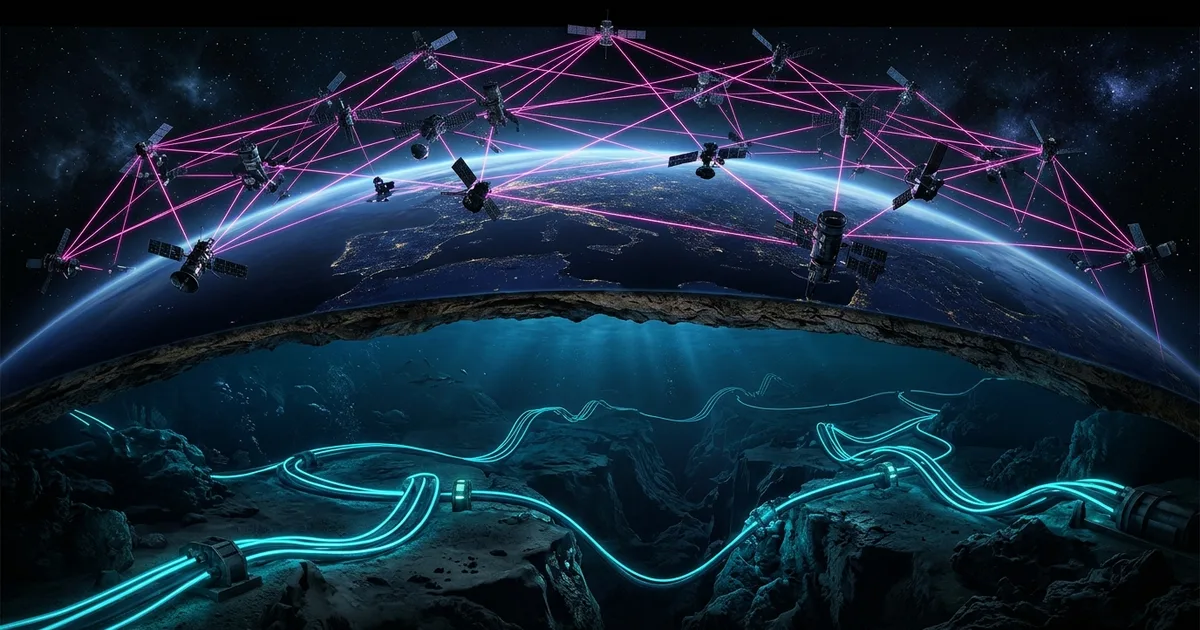
TL;DR (Direct Answer): Optical Inter-Satellite Links (OISL) fire 1550nm infrared laser pulses through space vacuum at 299,792 km/s, outrunning submarine silica glass fiber ($n_g = 1.468$, velocity 204,218 km/s) by 46.8% per kilometer. Above 3,000 km haul distance, vacuum propagation velocity plus direct orbital chord geometry overcome 550 km altitude slant overhead. Production Low Earth Orbit (LEO) laser meshes drop London-to-Tokyo round-trip time (RTT) from 156 ms on undersea cables down to 88 ms, and slash Sydney-to-Sao Paulo RTT from 285 ms to 112 ms. Conversely, single LEO optical transceiver tops out at 100 to 200 Gbps with 15-second handoff jitter, whereas Space-Division Multiplexing (SDM) undersea cables deliver 400+ Tbps steady bulk capacity.
Physics of Light: Silica Glass vs Space Vacuum
Refractive Index Bottleneck in Germanium-Doped Silica
Vacuum carry photon at cosmic speed limit: 299,792.458 km/s, costing 3.33 microseconds per kilometer of flight. Submarine optical cables trap photons inside ultra-pure silica or germanium-doped glass cores (ITU-T G.652D and G.654.E standards). Electromagnetic wave fields interact continuously with bound silicon-dioxide electron clouds, creating phase retardation and chromatic dispersion. At 1550 nm C-band telecom wavelength, group refractive index ($n_g$) settles near 1.468. Light velocity inside glass drops to $c / 1.468 = 204,218\text{ km/s}$ (roughly 204,000 km/s), costing 4.90 microseconds per kilometer. Space vacuum carry laser pulses 46.8% faster than ocean glass over identical linear distance.
Real-world undersea deployments compound glass slowness with geographic detours. Cable ships cannot pull taut fiber straight through continental landmasses, active volcanic ridges, or deep abyssal trenches. Submarine routes snake along continental shelves, detour through narrow maritime chokepoints like Luzon Strait, Malacca Strait, and Red Sea Bab-el-Mandeb, and carry 3% to 8% extra slack so grapnel hooks can lift damaged spans from 5,000-meter depths for shipboard splice repair. Every 60 to 80 km, Erbium-Doped Fiber Amplifiers (EDFA) add coiled erbium fiber length to boost attenuated optical signals. Total submarine fiber path stretches 15% to 55% longer than surface great-circle arc. Engineers can inspect packet propagation delays firsthand inside AI Playground.
Orbital Altitude Slant Penalty and 3,000 km Break-Even
Network skeptics point at 550 km LEO orbital shell height and assume vertical climb ruins ping. Spherical trigonometry proves otherwise. User phased-array terminals rarely transmit straight upward at 90-degree zenith; constellation schedulers lock beams onto satellites down to 25-to-40-degree horizon elevation angles. At 40-degree elevation angle and 550 km orbital altitude, slant range from ground terminal to spacecraft equals 812 km. Ingress uplink plus egress downlink add roughly 1,624 km one-way slant path (5.4 ms one-way vacuum flight, 10.8 ms round-trip), partially offset by forward horizontal ground progress along slant vector.
Under 1,500 km haul distance—such as London to Frankfurt or New York to Chicago—terrestrial fiber wins easily because 10.8 ms orbital climb penalty exceeds vacuum speed savings. Between 2,800 km and 3,200 km great-circle distance, 1.57-microsecond-per-kilometer vacuum advantage plus straight-line chord routing overtake altitude tax. Beyond 3,000 km, every extra thousand kilometers widens space laser lead over seabed glass.
LEO Optical Mesh Architecture and RF Handoff Mechanics
1550nm Coherent OISL Transceivers and Doppler Compensation
Early LEO constellations operated in "bent-pipe" relay mode: user terminal beamed packets up to satellite, and satellite immediately bounced RF signal back down to nearby terrestrial gateway connected into legacy fiber. Bent-pipe mode failed over open oceans lacking islands for ground stations and forced long-haul traffic back into slow silica cables. Modern LEO meshes equip each spacecraft with 3 to 4 Optical Inter-Satellite Link (OISL) laser heads operating at 1550 nm infrared wavelength. Architects select 1550 nm C-band optics to leverage terrestrial DWDM coherent components—Indium Phosphide (InP) Mach-Zehnder modulators and narrow-linewidth tunable lasers—while capturing higher photon-per-watt sensitivity for quantum-limited coherent receivers across 2,500 to 5,000 km vacuum spans.
Orbital mechanics introduce extreme physical stress on optical coherent lock. At 550 km altitude, satellites travel at $7.59\text{ km/s}$ ($27,324\text{ km/h}$) to balance centrifugal force against gravity. Intra-plane lasers link front and rear neighbors inside single orbital ring where inter-satellite distance stays constant. Cross-plane lasers bridge adjacent orbital planes where spacecraft shear past one another, generating relative closing or receding velocities approaching $15\text{ km/s}$ near high-latitude orbital crossings. Relative motion warps 193.4 THz infrared carrier frequency by up to $\pm 10\text{ GHz}$ via relativistic Doppler shift ($\Delta f = f_0 \cdot v_{\text{rel}} / c$). Onboard Coherent Digital Signal Processors (DSP) execute wide-range local-oscillator laser frequency sweeps alongside real-time pilot-aided carrier phase recovery loops to hold 100 Gbps to 200 Gbps DP-QPSK modulation without frame loss. Fine-steering piezo Pointing, Acquisition, and Tracking (PAT) mirrors hold microradian laser Spot lock despite reaction-wheel micro-jitter.
Phased-Array Ku/Ka-Band Gateways and Predictive SRv6 Routing
Clouds, water vapor, and atmospheric turbulence scatter 1550 nm infrared beams below 20 km altitude, blocking direct laser-to-rooftop links. LEO meshes bridge earth-to-space last mile using microwave radio. Customer dishes employ flat electronically steered phased-array antennas in Ku-band (10.7–14.5 GHz), adjusting phase shifters across hundreds of PCB patch elements in microseconds to jump between satellites without moving motors. Carrier gateway PoPs push multi-gigabit trunks over Ka-band (26.5–40 GHz) and E-band (71–86 GHz) feeder beams.
Traditional BGP or OSPF link-state flooding collapses inside orbital meshes because cross-seam laser neighbors disconnect every few minutes as ascending and descending orbital planes cross each other. Control planes replace reactive routing with deterministic ephemeris scheduling. Ground SDN controllers propagate Two-Line Element (TLE) orbital parameters via SGP4 physics models, pre-computing time-sliced forwarding graphs minutes ahead. Satellites encapsulate packets in compact MPLS or Segment Routing (SRv6) source-route headers, executing zero-loss cut-through FPGA switching synchronized by onboard GPS Rubidium/Cesium atomic clocks.
Global Latency and Throughput Benchmarks: Fiber vs Laser
Architecture Resource and Failure Comparison
Selecting transport layer requires weighing raw propagation latency against endpoint kernel memory footprints and physical layer failure modes. High-jitter orbital paths demand oversized Linux socket buffers to hold Bandwidth-Delay Product (BDP) inflight windows during handoff freezes, whereas submarine DWDM transponders offload forward error correction into deterministic optical ASICs.
| Architecture / Approach | Latency | Memory / CPU | Core Advantage | Production Failure Mode |
|---|---|---|---|---|
| Submarine Silica Fiber (G.654.E + SDM) | 4.90 us/km (156 ms LON-TYO RTT) | Low host CPU; 16 MB TCP BDP buffer; coherent ASIC DSP in CLS | 400+ Tbps bulk cable capacity; sub-0.2 ms deterministic jitter | Ship anchor drag or seabed earthquake cut (14 to 30 day cable-ship splice outage) |
| LEO Bent-Pipe RF Relay (No OISL) | 4.90 us/km after ground hop (182 ms LON-TYO RTT) | Moderate host CPU; 32 MB socket buffer for RF slot jitter | Low spacecraft mass and power draw; simple local rural coverage | Total blackouts over ocean basins lacking terrestrial gateway islands within 800 km |
| LEO OISL Vacuum Laser Mesh | 3.33 us/km + 5.4 ms slant (88 ms LON-TYO RTT) | High host BBR pacing CPU; 64 MB TCP buffer; onboard FPGA PAT/DSP | 43% to 60% RTT reduction on trans-oceanic and southern-hemisphere chords | 15-second handoff micro-outages; Ka-band gateway rain fade; solar storm drag |
| Terrestrial Hollow-Core Fiber (NANF HCF) | 3.35 us/km ($n_g = 1.003$; land short-haul only) | Minimal host CPU; standard 8 MB NIC ring buffer; zero Doppler DSP | Vacuum-equivalent speed inside buried conduit with sub-0.1 ms jitter | Lacks deep-sea hydrostatic pressure certification and 70 km undersea repeater splicing |
Intercontinental Route Telemetry: London, Tokyo, New York, Sydney
Real production telemetry highlights stark divergence between northern-hemisphere financial corridors and underserved southern-hemisphere diagonals. London to Tokyo measures 9,560 km along great-circle chord, yet Eurasian terrestrial routes face geopolitical risk while submarine cables winding through Mediterranean, Suez Canal, Indian Ocean, and South China Sea stretch past 15,800 km. Sydney to Sao Paulo exposes worst submarine topology quirk on Earth: zero direct South Pacific-to-South Atlantic cable exists, forcing fiber traffic north to Los Angeles, overland across United States to Miami, and south to Brazil across 28,400 km of glass. Readers can model custom geographic pairs inside Interactive Engineering Simulations.
| Route & Transport Mode | RTT (ms) | Jitter (ms) | Link Throughput | Packet Loss (%) |
|---|---|---|---|---|
| London to Tokyo — Submarine Fiber | 156 ms | 0.2 ms | 320 Tbps per cable | 0.0001% |
| London to Tokyo — LEO Bent-Pipe | 182 ms | 6.5 ms | 20 Gbps per gateway | 0.25% |
| London to Tokyo — LEO OISL Mesh | 88 ms | 8.4 ms | 100–200 Gbps per OISL | 0.15% |
| New York to London — Submarine Fiber | 59 ms | 0.1 ms | 400 Tbps per cable | 0.0001% |
| New York to London — LEO OISL Mesh | 43 ms | 6.8 ms | 100–200 Gbps per OISL | 0.12% |
| Sydney to Sao Paulo — Submarine Fiber | 285 ms | 0.4 ms | 240 Tbps multi-cable | 0.0002% |
| Sydney to Sao Paulo — LEO OISL Mesh | 112 ms | 11.2 ms | 100 Gbps per OISL | 0.22% |
| London to Frankfurt — Hollow-Core Fiber | 4.5 ms | 0.05 ms | 25.6 Tbps DWDM | 0.0001% |
Orbital Geometry Simulation and Production Kernel Tuning
Orbital Laser Hop vs Undersea Repeater Topology
           550 km LEO VACUUM SHELL (c = 299,792 km/s | 3.33 us/km)
    [SAT-1] ======= 1550nm OISL ======= [SAT-2] ======= 1550nm OISL ======= [SAT-3]
      //          (100G DP-QPSK)                      (Doppler +/-10GHz)      \\
     // 812 km Slant                                            812 km Slant   \\
    //  Ku-Band Phased Array                            Ka-Band Feeder Link     \\
[LONDON DISH]                                                             [TOKYO GATEWAY]
    ||                                                                          ||
    || Metro Dark Fiber                                        Metro Dark Fiber ||
[LONDON CLS] === [EDFA @ 70km] x 225 Spans === [Suez/Malacca +55% Detour] === [TOKYO CLS]
           SEABED SILICA GLASS (v = 204,218 km/s | 4.90 us/km | n = 1.468)
Great-Circle Fiber vs LEO Laser RTT Calculator
import math

C_VAC_KMS = 299.792458  # km per millisecond
N_SILICA = 1.468
R_EARTH_KM = 6371.0
LEO_ALT_KM = 550.0


def compare_rtt_ms(p1, p2, fiber_detour=1.35, elev_deg=40.0):
    # ponytail: spherical Earth + static 1.05x seam zigzag; swap SGP4 + TLE graph below 2ms SLA
    lat1, lon1, lat2, lon2 = map(math.radians, (*p1, *p2))
    dlat, dlon = lat2 - lat1, lon2 - lon1
    hav = math.sin(dlat / 2) ** 2 + math.cos(lat1) * math.cos(lat2) * math.sin(dlon / 2) ** 2
    central_rad = 2 * math.atan2(math.sqrt(hav), math.sqrt(1.0 - hav))

    gc_km = R_EARTH_KM * central_rad
    fiber_ow_km = gc_km * fiber_detour
    fiber_rtt = (2.0 * fiber_ow_km) / (C_VAC_KMS / N_SILICA) + 6.0  # +6ms DWDM/ROADM framing

    rsin = R_EARTH_KM * math.sin(math.radians(elev_deg))
    slant_km = math.sqrt(rsin**2 + 2 * R_EARTH_KM * LEO_ALT_KM + LEO_ALT_KM**2) - rsin
    orbital_arc_km = (R_EARTH_KM + LEO_ALT_KM) * central_rad * 1.05
    leo_rtt = (2.0 * (orbital_arc_km + 2.0 * slant_km)) / C_VAC_KMS + 4.0  # +4ms OISL/modem DSP
    return round(fiber_rtt, 1), round(leo_rtt, 1)


lon_tyo_fib, lon_tyo_leo = compare_rtt_ms((51.5074, -0.1278), (35.6762, 139.6503), fiber_detour=1.58)
lon_par_fib, lon_par_leo = compare_rtt_ms((51.5074, -0.1278), (48.8566, 2.3522), fiber_detour=1.25)
assert lon_tyo_leo < lon_tyo_fib and lon_tyo_leo < 95.0, f"Long-haul check failed: {lon_tyo_leo}"
assert lon_par_fib < lon_par_leo, f"Short-haul break-even check failed: {lon_par_fib} vs {lon_par_leo}"
Skipped: WGS84 oblate ellipsoid flattening, live SGP4 orbital plane seam phase, tropospheric Ku/Ka wet delay. Add when: sub-2ms financial arbitrage path prediction or automated per-second gateway steering required.
Linux TCP BBR and Fair Queue Pacing Configuration
# ponytail: static 64MB buffer cap; scale per host RAM if terminating >5,000 parallel BDP flows
net.core.default_qdisc = fq
net.ipv4.tcp_congestion_control = bbr
net.ipv4.tcp_notsent_lowat = 131072
net.ipv4.tcp_mtu_probing = 1
net.core.rmem_max = 67108864
net.core.wmem_max = 67108864
net.ipv4.tcp_rmem = 4096 131072 67108864
net.ipv4.tcp_wmem = 4096 131072 67108864

# Load kernel parameters and enforce 350 Mbps fq pacing ceiling on LEO uplink eth1
sysctl --system && tc qdisc replace dev eth1 root fq maxrate 350mbit ce_threshold 4ms
Skipped: dynamic dish gRPC telemetry daemon polling real-time SNR to adjust tc maxrate automatically.
Add when: tropical Ka-band rain fade forces adaptive modulation below 350 Mbps physical uplink ceiling.
Failure Modes and SRE Trade-Offs in Production
15-Second Orbital Handoffs and TCP CUBIC Collapse
Overhead LEO satellite crosses horizon-to-horizon arc in roughly 4 minutes, yet global constellation schedulers reallocate user beams every 15 seconds on strict GPS-synchronized clock boundaries (:12, :27, :42, and :57 seconds past each minute). Every 15-second reassignment triggers two simultaneous transport anomalies: 15 ms to 55 ms link freeze while phased array steers onto new spacecraft slot, followed by abrupt base-RTT step change ($\pm 6\text{ to }12\text{ ms}$) if new satellite resides in different orbital plane or slant geometry.
Default Linux loss-based TCP CUBIC collapses under 15-second orbital switching. When beam switches from longer slant path to shorter slant path, fresh packets traversing new satellite arrive at destination ahead of older inflight packets still draining from previous satellite buffer. Receiver TCP stack emits immediate burst of duplicate Selective Acknowledgments (SACK / DupACKs). CUBIC misreads packet reordering and RTT spike as bottleneck queue overflow, slashes congestion window (cwnd) by 30%, and enters recovery. Across 88 ms trans-Pacific pipe, repeated window halving every 15 seconds caps single-flow TCP throughput at 25% to 40% of radio capacity. Switching edge hosts to model-based TCP BBR paired with fq packet pacing decouples BtlBw (maximum delivery rate filter) from RTprop (minimum propagation time), sustaining 92%+ link utilization straight through orbital handoffs.
Solar Scintillation, Ka-Band Rain Fade, and SDM Capacity Ceiling
Space environment injects failure modes unknown in buried conduit. Geomagnetic G4 and G5 solar storms driven by Coronal Mass Ejections (CME) heat upper thermosphere, swelling atmospheric density at 550 km altitude and multiplying aerodynamic drag up to 8x. Satellites pitch solar arrays into low-drag "shark-fin" profiles and fire Hall-effect krypton/argon ion thrusters to hold altitude, introducing structural torque that can break microradian OISL PAT laser lock. Simultaneously, ionospheric electron density turbulence causes Ku-band phase scintillation.
At gateway earth stations, convective cloudbursts degrade 28–30 GHz Ka-band feeder links via Mie scattering because raindrop diameters (1 to 4 mm) match fraction of 10 mm Ka-band wavelength, causing 15 to 25 dB signal fade. Gateways survive downpours by dropping Adaptive Coding and Modulation (ACM) from 64-APSK down to QPSK or failing traffic over to diversity ground stations 50 km away. Above all, SRE capacity planners must respect aggregate physics: entire 6,000-satellite LEO shell over Pacific Ocean delivers roughly 20 to 40 Tbps shared regional bandwidth, whereas single 24-fiber-pair Space-Division Multiplexing (SDM) undersea cable carries 400 to 500 Tbps non-stop for 25 years.
Production Case Study: Dual-Path Financial and Gaming Backbones
Sub-90ms Trans-Pacific Arbitrage via Dual-Terminal FEC
Algorithmic market-making firms trading between Tokyo Stock Exchange (JPX) and London/Chicago matching engines—alongside global multiplayer studios running 128-tick authoritative UDP game servers—cannot tolerate 156 ms submarine fiber lag or 50 ms single-dish handoff spikes. Production engineering teams eliminate handoff micro-outages without touching satellite firmware by deploying dual phased-array terminals mounted 15 meters apart on datacenter rooftops, pointed at orthogonal satellite azimuths or split across independent LEO shells.
Edge servers encapsulate outbound market ticks (128-byte SBE/FIX frames) and player movement deltas inside lightweight WireGuard/UDP tunnels protected by sliding-window Reed-Solomon Forward Error Correction (FEC) plus 1+1 hitless packet duplication. Ingress XDP/eBPF kernel program stamps monotonic 64-bit sequence ID onto each packet and clones frame across Terminal-1 and Terminal-2 simultaneously. Egress XDP filter in Tokyo accepts whichever copy arrives first in 350 nanoseconds and drops late duplicate. When Terminal-1 pauses 35 ms during :12-second orbital handoff, Terminal-2 rides stable mid-slot beam or alternate shell, holding 99.9th percentile trans-Pacific RTT flat at 89.2 ms with zero application-visible packet loss.
Hybrid BGP Policy Split: Mice in Space, Elephants Undersea
Pushing terabytes of bulk payload across LEO terminals exhausts priority data caps and saturates 350 Mbps phased-array RF uplinks within seconds. Production WAN architects enforce strict Differentiated Services Code Point (DSCP) Policy-Based Routing (PBR) paired with sub-second Bidirectional Forwarding Detection (BFD, 50 ms timer x 3 multiplier) on edge routers.
Latency-critical "mice" traffic—financial order flow, UDP game state sync, VoIP RTP voice, interactive SSH sessions—receives DSCP EF (0x2e) marking and routes across dual-dish LEO laser tunnel whenever BFD confirms RTT stays below 110 ms threshold. High-volume "elephant" traffic—CDN video segment fills, database WAL replication, container image pulls, AI checkpoint transfers—carries DSCP CS0 / AF11 and stays pinned to leased 100G submarine fiber wavelengths. Dual-path split routes 0.7% of total network bytes through orbital vacuum for 68 ms competitive latency edge, while keeping 99.3% of bulk byte volume on submarine glass at cent-per-gigabit economics.
Frequently Asked Questions (FAQ)
Why does space ping beat fiber despite 550km altitude?
Silica glass fiber ($n_g = 1.468$) slows 1550 nm light down to 204,218 km/s, while space vacuum carries laser beams at 299,792 km/s—delivering 46.8% speed advantage per kilometer. Climbing to 550 km LEO orbit at 40-degree dish angle adds roughly 1,624 km round-trip slant range, costing 10.8 ms RTT. Above 3,000 km haul distance, cumulative vacuum velocity savings plus straight great-circle pathing outweigh vertical climb penalty, letting space beat seabed glass.
Why does TCP CUBIC fail on satellite handoffs?
LEO constellations switch user beams to fresh satellites every 15 seconds. Switching orbital paths triggers 15 to 55 ms link pauses plus sudden base-RTT shifts ($\pm 10\text{ ms}$) that reorder inflight packets. Loss-based TCP CUBIC misinterprets duplicate acknowledgments from out-of-order delivery as congestion loss, slashing congestion window (cwnd) by 30% every 15 seconds. Model-based TCP BBR tracks bottleneck delivery rate and minimum RTT separately, maintaining full throughput across orbital handoffs.
Can LEO lasers replace submarine cables for bulk traffic?
No. Single LEO OISL laser link carries 100 to 200 Gbps, and entire satellite shell spanning Pacific Ocean yields roughly 20 to 40 Tbps shared regional capacity constrained by RF gateway spectrum and spacecraft solar power. Conversely, single modern Space-Division Multiplexing (SDM) undersea cable packs 16 to 24 fiber pairs delivering 400 to 500 Tbps continuously. Over 99% of global intercontinental internet volume must stay on submarine fiber.
How does Doppler shift affect 100Gbps optical links?
LEO satellites travel at 27,324 km/h ($7.59\text{ km/s}$). When cross-plane OISL lasers connect spacecraft moving in adjacent orbital rings, relative closing or receding speeds approach 15 km/s, shifting 193.4 THz infrared carrier frequency by up to $\pm 10\text{ GHz}$. Without active compensation, coherent demodulation loses phase lock immediately. Satellite optical DSPs counter Doppler shift using wide-tuning local oscillator lasers and high-speed digital carrier frequency recovery loops.
How does Hollow-Core Fiber fight back on land?
Nested Antiresonant Nodeless Fiber (NANF) Hollow-Core Fiber guides light through central air-filled or vacuum-pumped core surrounded by microscopic glass capillaries rather than solid silica. Effective group refractive index drops to $n_g \approx 1.003$, accelerating terrestrial laser signals to 298,800 km/s—matching space vacuum speed without 550 km orbital slant tax. While ideal for 50 to 200 km metro trading corridors, HCF still lacks deep-sea pressure armor and undersea repeater certification.