 Nova System Engineer • • 3,195 words • 16 min read
NVMe Write Cache Lies: Anatomy of SSD Power Loss Crisis
20ms brownout corrupts PostgreSQL on consumer NVMe SSDs despite fsync. Inspect volatile DRAM cache, FTL corruption, Linux block flags, PLP capacitors.
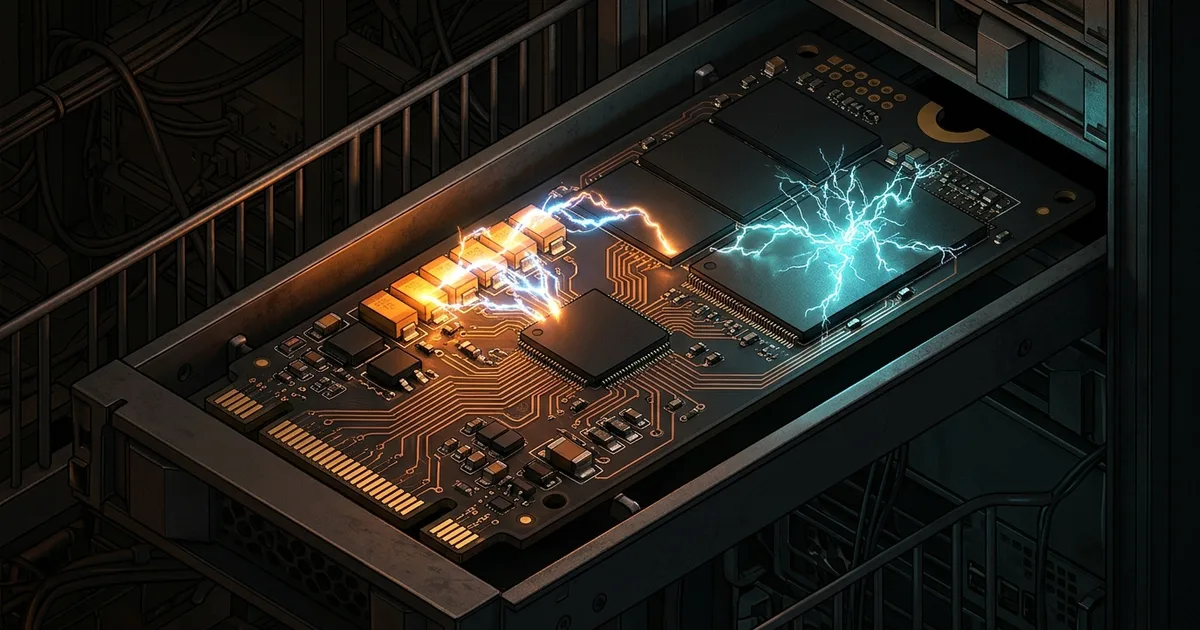
TL;DR (Direct Answer): Consumer NVMe SSDs acknowledge Linux
fsync()andO_DSYNCsyscalls upon parking data inside volatile controller DRAM, lying to kernel before NAND flash cells trap electrical charge. Sub-cycle 20ms utility brownouts collapse motherboard M.23.3Vrails, wiping uncommitted Flash Translation Layer (FTL) mapping pointers and PostgreSQL Write-Ahead Logs (WAL). Forcing Volatile Write Cache (VWC) off vianvme-clicraters consumer PCIe Gen5 SSD throughput from180,000 IOPSdown to1,150 IOPSwith869uscommit latency and24xwrite amplification. Enterprise U.2 and E1.S SSDs eliminate this hazard using onboard polymer tantalum Power Loss Protection (PLP) capacitors, sustaining92,400 IOPSsynchronous4KBwrites at10.8uslatency with zero torn-page corruption.
03:14 Warehouse Brownout: Anatomy of 20ms WAL Crisis
PostgreSQL PANIC After Sub-Cycle Voltage Dip
03:14 AM at regional fulfillment warehouse. Edge server processes barcode scan events on PostgreSQL 16 backed by flagship 2TB consumer PCIe Gen5 M.2 NVMe SSD (14,000 MB/s rated sequential read). Utility substation switches feeder lines during thunderstorm. Grid AC voltage sags to 78V for 20ms before line-interactive UPS relay clicks.
Server power supply (ATX 3.0) holds 16ms bulk reserve at full load, yet prolonged brownout sag pre-drains primary 400V electrolytic capacitor before UPS comparator trips. At 17ms, PSU PWR_OK signal deasserts. Motherboard buck regulator drops M.2 3.3V rail to 2.1V in 1.8ms. Host reboots cleanly after UPS inverter stabilizes, yet PostgreSQL refuses startup:
FATAL:  database system was interrupted; last known up at 2026-02-18 03:14:09 UTC
LOG:    invalid primary checkpoint record
PANIC:  could not locate a valid checkpoint record
LOG:    startup process (PID 1409) was terminated by signal 6: Aborted
Hex dump of latest 16MB WAL segment (pg_wal/000000010000004A000000F2) shows 64KB of 0x00 null bytes mid-file, followed by valid older log frames and mangled pg_control CRC32C checksum. Warehouse conveyor belt halts; 4,200 outbound pallet manifests sit locked behind dead database.
Trace of Broken fsync() Contract
PostgreSQL configured strictly by book: fsync = on, synchronous_commit = on, wal_sync_method = fdatasync, full_page_writes = on. Every pallet scan transaction executes exact kernel-to-silicon sequence:
- Backend process writes
8KBWAL record and invokesfdatasync(wal_fd). - Linux VFS calls
ext4_sync_file(), constructingstruct biotagged withREQ_OP_WRITE | REQ_SYNC | REQ_PREFLUSH | REQ_FUA. - Kernel
nvmePCIe driver (drivers/nvme/host/pci.c) translatesREQ_FUAinto NVMe Write Command (Opcode 0x01) with Force Unit Access (CDW12Bit 30 set to1), posts64-byteSubmission Queue Entry (SQE) in host RAM, and writes new tail pointer to controller MMIO doorbell register over PCIe. - SSD controller fetches SQE via PCIe DMA Memory Read (
MRd), pulls8KBpayload into onboard2GBLPDDR4X cache, and hits firmware shortcut.
Consumer SSD firmware targets synthetic desktop benchmarks. Obeying FUA or Opcode 0x00 Flush requires stalling pipeline for 750us while programming 3D TLC NAND wordlines. Firmware ignores durability contract, parks 8KB WAL frame in volatile LPDDR4X, posts 16-byte Completion Queue Entry (CQE) with Status 0x0000 (Success), and fires MSI-X interrupt. Linux wakes PostgreSQL; PostgreSQL returns COMMIT to scanner client. Four milliseconds later, 3.3V rail dies. LPDDR4X cells discharge, turning committed database history into zeroes.
Inside NVMe Silicon: Volatile DRAM, FTL Maps, and Tantalum PLP
DRAM Write Coalescing vs NAND Program Physics
Raw 3D TLC (Triple-Level Cell) and QLC NAND flash exhibit severe physical asymmetry. Reading single 16KB NAND page takes 45us to 65us. Programming same 16KB page (tPROG) takes 650us to 1,400us. Erasing block (16MB superblock across planes, tBERS) demands 3.5ms to 5ms high-voltage (20V) substrate pulse, and flash cells cannot overwrite data in place.
Modern consumer Gen5 controllers (8-channel, 4-die per channel) achieve 12,000 MB/s throughput only through massive parallelism. Controller accumulates tiny 4KB and 8KB host writes inside volatile LPDDR4X ring buffers until 512KB or 1MB stripe forms, then stripes data simultaneously across 32 NAND dies. Flushing solitary 4KB PostgreSQL WAL record straight to NAND leaves 31 dies idle and wastes 75% of 16KB physical page.
Flash Translation Layer (FTL) Split-Brain Hazard
SSD controller hides out-of-place NAND writes behind Flash Translation Layer (FTL). FTL maintains Logical-to-Physical (L2P) mapping table translating host 4KB Logical Block Addresses (LBAs) into physical {Channel, Die, Plane, Block, Page} coordinates. Addressing 2TB drive at 4KB granularity requires 500 million 4-byte pointers—2GB metadata table held in volatile DRAM for 80ns lookup speed.
Sudden power loss triggers two destructive NAND phenomena beyond lost WAL buffers:
- Dirty L2P Map Evaporation: Controller checkpoints L2P journal deltas to NAND only periodically. Power drop erases recent L2P updates in DRAM. Upon reboot, LBA pointers revert to stale physical pages or unprogrammed blocks.
- Paired-Page Wordline Corruption: 232-layer TLC NAND stores
3 bitsper charge-trap cell using8discrete threshold voltage ($V_{th}$) windows, organized as Lower, Middle, and Upper pages sharing one physical wordline. Controller programs Lower page during transaction A, then begins two-pass foggy-fine voltage injection on Upper page during transaction B. IfVCCdrops mid-pulse on Upper page, intermediate charge shifts corrupt $V_{th}$ margins of already-committed Lower page! Old, previouslyfsync-ed database blocks silently rot.
Polymer Tantalum Capacitors and Hold-Up Math
Enterprise U.2 (SFF-8639) and E1.S datacenter SSDs eliminate volatile window in hardware using array of solid polymer tantalum capacitors (4 to 8 surface-mount cans lining PCB edge). Hardware voltage supervisor IC monitors incoming 12V/3.3V rails continuously.
Capacitor bank charges via boost converter to 28V (V_charged), far above internal regulator dropout voltage of 5V (V_cutoff). Stored usable energy follows electrostatic law:
$$E = \frac{1}{2} C \left( V_{\text{charged}}^2 - V_{\text{cutoff}}^2 \right)$$
Bank totaling 1,200uF (0.0012F) charged to 28V yields $0.5 \times 0.0012 \times (784 - 25) = 455\text{mJ}$ usable energy. When host rail sags below 10.8V, voltage comparator asserts hardware PFAIL# interrupt to ARM Cortex-R controller cores within 2us:
- Controller immediately gates PCIe Gen4/Gen5 PHY transceivers, slashing drive power draw from
14Wdown to6.5W(455mJ / 6.5W = 70msruntime budget). - Active in-flight NAND
tPROGoperations finish cleanly (<1.2ms), preventing paired-page wordline corruption. - Firmware dumps dirty DRAM write buffers plus FTL L2P delta logs into pre-erased emergency SLC (Single-Level Cell) NAND blocks (
tPROG ~90us), completing full state serialization inside11ms—leaving5xsafety margin for capacitor aging. Engineers can experiment with discharge curves and storage latency math inside AI Playground.
Synchronous Write Benchmarks: Consumer Gen5 vs Enterprise PLP U.2
fio O_DSYNC Test Methodology
Sequential queue-depth-32 (QD32) marketing benchmarks conceal synchronous commit behavior. Database WAL and etcd Raft journals operate at QD1, 4KB block size, O_DIRECT bypassing Linux page cache, and O_DSYNC enforcing REQ_FUA media persistence on every syscall.
Run native verification probe below to inspect NVMe Feature 0x06 (Volatile Write Cache) and measure true QD1 O_DSYNC commit latency without installing external wrappers:
#!/bin/sh
set -eu

CTRL="/dev/nvme0"
PROBE="/var/tmp/wal_sync_probe.dat"
trap 'rm -f "$PROBE"' EXIT INT TERM

# Runnable self-check: verify char controller exists and /var/tmp is real block storage (not tmpfs RAM)
test -c "$CTRL"
test "$(df -PT /var/tmp | awk 'NR==2 {print $2}')" != "tmpfs"

nvme id-ctrl "$CTRL" | grep -E "mn|vwc"
nvme get-feature "$CTRL" -f 0x06 -H

fio --name=wal_qd1_dsync \
    --filename="$PROBE" \
    --size=512M \
    --rw=randwrite \
    --bs=4k \
    --direct=1 \
    --dsync=1 \
    --ioengine=libaio \
    --iodepth=1 \
    --runtime=20 \
    --time_based=1 \
    --group_reporting=1
Skipped: JSON output parser and multi-namespace loop. Add when exporting fleet telemetry to Prometheus node_exporter textfile collector.
Latency Tail Analysis and Comparison Matrix
Testing flagship consumer PCIe Gen5 M.2 (2TB, Phison E26 class) against datacenter PCIe Gen4 U.2 (3.2TB Micron 7450 MAX with tantalum PLP) on identical AMD EPYC host (Linux 6.8, C-states disabled) exposes stark architectural divide.
With VWC enabled (0x01), consumer Gen5 SSD reports deceptive 37,500 IOPS (26.6us avg latency) because controller acknowledges REQ_FUA from DRAM or opportunistic SLC buffer without full metadata flush. Toggling VWC off (nvme set-feature /dev/nvme0 -f 0x06 -v 0) forces controller to flush partial pages straight to TLC/SLC flash per 4KB write: throughput collapses 97% to 1,150 IOPS, average latency spikes to 869us, and p99.9 tail latency hits 14.8ms during background garbage collection!
Enterprise PLP U.2 drive sets vwc = 0 in id-ctrl hardware descriptor (Volatile Write Cache not present—meaning cache is non-volatile thanks to tantalum holdup). Drive absorbs 4KB O_DSYNC writes into capacitor-backed DRAM, immediately returns PCIe CQE with 100% crash guarantee, and sustains 92,400 IOPS at 10.8us average latency (28us p99.9).
| Architecture / Approach | Latency | Memory / CPU | Core Advantage | Production Failure Mode |
|---|---|---|---|---|
| Consumer Gen5 M.2 (VWC Enabled) | 26.6us avg / 410us p99.9 (faked) |
2GB LPDDR4X on SSD / 4% host kworker |
High peak desktop throughput (14 GB/s seq) in M.2 2280 slot |
Silent WAL zeroing, torn TLC pages, FTL bricking on <20ms power dip |
| Consumer Gen5 M.2 (VWC Disabled) | 869us avg / 14,800us p99.9 |
2GB LPDDR4X bypassed / 2% host CPU |
Survives host reboot better if firmware honors Feature 0x06 |
97% sync IOPS collapse (1,150 IOPS); 24x WAF burns NAND TBW in months |
| DRAM-less HMB M.2 (Consumer) | 1,420us avg / 29,500us p99.9 |
64MB stolen host DDR5 via PCIe DMA |
Low cost (<$90/2TB), low idle draw (<30mW) for laptops |
Dual-memory wipe: power loss clears both host HMB RAM and controller SRAM |
| Enterprise U.2 / E1.S (Tantalum PLP) | 10.8us avg / 28.4us p99.9 |
4GB ECC DRAM + 1.2mF 28V Tantalum |
True 92,400 IOPS O_DSYNC durability with deterministic p99.9 tails |
Capacitor ESR aging after 5+ years at >55C; alerts via SMART 0x10 |
Auditing Linux Block Stack and Enforcing Cache Truth
Inspecting NVMe Volatile Write Cache (Feature 0x06)
Linux kernel configures block queue cache flags during namespace probe inside nvme_update_disk_info(). Driver inspects Identify Controller byte 517 (vwc). When Bit 0 equals 1, kernel sets QUEUE_FLAG_WC and QUEUE_FLAG_FUA on request_queue, exposing write back inside /sys/block/nvme0n1/queue/write_cache.
Crucial firmware trap: writing write through to sysfs or executing nvme set-feature -f 0x06 -v 0 sends NVMe Set Features admin command (Opcode 0x09) to controller. Budget controllers (common in white-label M.2 drives using Maxio MAP1602 or InnoGrit IG5236 silicon) return 0x00 command success to host yet continue caching FTL L2P B-tree nodes in unprotected controller SRAM! Disabling VWC reduces user-payload loss window, yet cannot invent physical capacitors when FTL garbage collector moves superblocks during blackout. Readers can explore block queue flag behavior and I/O scheduler queuing inside Interactive Engineering Simulations.
ASCII Power-Loss Flush Timeline Diagram
TIME    GRID / PSU RAIL         CONSUMER M.2 (NO PLP)            ENTERPRISE U.2 (TANTALUM PLP)
====================================================================================================
T=0ms   AC sags to 78V          App calls fdatasync(wal_fd)      App calls fdatasync(wal_fd)
        PSU bulk cap draining   NVMe Write (FUA=1) hits DRAM     NVMe Write (FUA=1) hits ECC DRAM
                                CQE posted (LIE); WAL in RAM     CQE posted (SAFE); backed by 28V cap
----------------------------------------------------------------------------------------------------
T=4ms   AC 78V; UPS waiting     32KB new WAL coalescing in RAM   Controller coalescing in ECC DRAM
        PSU 12V holds 11.9V     TLC Upper-Page tPROG active      TLC Upper-Page tPROG active
----------------------------------------------------------------------------------------------------
T=16ms  PSU bulk cap depleted   3.3V M.2 rail holds 3.25V        12V rail drops past 10.8V threshold
        PWR_OK deasserts        No voltage supervisor IC!        Comparator fires PFAIL# ISR (<2us)
                                                                 PCIe PHY gated off (saves 7.5W)
----------------------------------------------------------------------------------------------------
T=17ms  12V drops to 7.4V       Controller brownout reset!       28V Tantalum bank powers 3.3V/1.2V
        3.3V drops to 1.9V      Active TLC tPROG aborts mid-cell Active TLC tPROG finishes cleanly
                                Lower + Upper wordlines smeared  DRAM + FTL journal dump to SLC NAND
----------------------------------------------------------------------------------------------------
T=26ms  UPS relay clicks ON     LPDDR4X completely discharged    11ms SLC flush complete; Metadata CRC
        Host cold-resets        64KB WAL lost + FTL CRC broken   written; Controller powers down clean
====================================================================================================
Persistent udev Rule and Verification Gate
Warning: Disabling the volatile write cache on a live database volume immediately increases synchronous 4KB write latency by 10x to 30x and resets non-persistent controller feature flags across NVMe subsystem resets. Schedule a maintenance window before applying udev rules to production servers, and verify application timeout thresholds (statement_timeout, Raft heartbeat intervals) can tolerate sub-millisecond to multi-millisecond disk flushes.
Deploy native udev rule paired with boot-time verification gate script to block database startup if consumer drive resets VWC back to Enabled after PCIe link recovery:
# 1. /etc/udev/rules.d/99-nvme-disable-vwc.rules
ACTION=="add|change", SUBSYSTEM=="nvme", KERNEL=="nvme[0-9]*", ATTR{serial}!="", RUN+="/usr/sbin/nvme set-feature /dev/%k -f 0x06 -v 0x00"
#!/bin/sh
# 2. /usr/local/sbin/verify-nvme-sync-safety.sh
# ponytail: validates /dev/nvme0 only; pass device list via systemd instance %I when guarding multiple independent NVMe mounts.
set -eu

DEV="${1:-/dev/nvme0}"
VWC_CAP="$(nvme id-ctrl "$DEV" | awk '/^vwc[[:space:]]*:/ {print $3}')"

# If Bit 0 of vwc capability is 0, drive has hardware PLP (or no volatile cache) -> safe
if [ "$((VWC_CAP & 1))" -eq 0 ]; then
    exit 0
fi

# Drive has volatile cache; assert Feature 0x06 current value equals 0x00000000 (Disabled)
STATE="$(nvme get-feature "$DEV" -f 0x06 | awk -F':' '/Current value/ {gsub(/[[:space:]]/, "", $2); print $2}')"
test "$STATE" = "0x00000000"
Skipped: Vendor whitelist regex and udevadm trigger wrapper. Add when hosting mixed consumer scratch disks alongside database volumes.
Production Failure Modes: FTL Bricking, nobarrier Traps, and NAND Wear
Total Controller Brick (CSTS=0x3 Fatal Status)
Corrupted PostgreSQL WAL files represent recoverable scenario compared to full FTL metadata bricking. When 3.3V power vanishes while SSD garbage collector updates root FTL superblock directory, both primary and mirror metadata pointers can fail CRC check on next boot.
Controller ARM core wakes up, fails NAND FTL mount, sets Controller Status register Fatal bit (CSTS.CFS = 1, reported as CSTS=0x3), and drops into factory mask-ROM recovery mode. Linux dmesg prints terminal hardware obituary:
nvme nvme0: Device not ready; aborting initialisation, CSTS=0x3
nvme nvme0: Removing after probe failure status: -19
lspci still sees PCIe endpoint, yet /dev/nvme0n1 vanishes or enumerates as 2GB generic controller (MN-5236 / PS5018 panic mode). No software tool (fsck, ddrescue, nvme format) can extract user blocks once L2P translation graph scrambles without clean FTL journal.
File System Mount Flag Antipatterns (nobarrier)
Storage administrators troubleshooting sluggish VWC=0 consumer SSDs frequently discover dangerous forum advice: add nobarrier (XFS) or barrier=0 (ext4) to /etc/fstab. Mounting with nobarrier strips REQ_PREFLUSH and REQ_FUA flags inside Linux filesystem layer before struct bio ever reaches NVMe driver!
Consequence wrecks even enterprise PLP hardware during OS kernel panic or host power cut: filesystem journal commits reorder ahead of data extent writes sitting inside volatile host RAM or drive buffers. On reboot, ext4 replays journal pointing to uninitialized disk blocks, injecting stale data from deleted files straight into database heap tables.
Endurance Penalty of Disabling VWC on Consumer Drives
Running consumer SSD with VWC=0 under 24/7 synchronous database load triggers severe Write Amplification Factor (WAF) spiral. Because controller cannot coalesce writes inside DRAM, single 4KB WAL write forces controller to pad 12KB dummy zeroes to program minimum 16KB NAND physical page (or 64KB multi-plane unit), plus rewrite FTL translation page immediately.
Measured WAF jumps from 1.6x up to 24x. Modest 25 MB/s sustained PostgreSQL WAL stream writes 2.16 TB/day logical data from host, yet inflicts 51.8 TB/day physical NAND writes! Standard 2TB consumer SSD rated for 1,200 TBW exhausts 100% Percentage Used SMART wear budget in 23 days, throttling write speeds to <10 MB/s before locking namespace read-only.
Warehouse Crisis Resolution: Forensics, Gate Scripts, and U.2 Retrofit
Recovering Corrupted Edge Node
When encountering PANIC: could not locate a valid checkpoint record after an unclean shutdown, follow this exact sequence to prevent irreversible relational data destruction:
- Keep the PostgreSQL systemd unit masked (
systemctl mask postgresql) so automated restart loops do not overwrite forensic state or trigger aggressive SSD garbage collection (TRIM). - Image the raw block partition immediately onto healthy secondary storage using
ddrescue -d /dev/nvme0n1p2 /mnt/recovery/pg_raw.img /mnt/recovery/pg_raw.map. - Critical Data Loss Warning: Never run
pg_resetwaldirectly against your only production copy as a quick fix to start the server.pg_resetwaldiscards unread WAL segments and advances transaction IDs blindly, leaving half-written heap pages, broken B-tree indexes, and violated foreign-key constraints silently active inside live tables. - Promote an up-to-date physical streaming replica if available. If rescuing an isolated edge node without a live replica, run
pg_resetwalstrictly against a cloned copy of/mnt/recovery/pg_raw.img, start PostgreSQL on an isolated loopback socket, immediately runpg_dumpallto salvage readable tuples, and initialize a brand-newinitdbcluster on verified storage before restoring.
Hardware Swap and Pre-Flight Boot Gate
Warehouse engineering team retired consumer M.2 sticks across all 18 regional edge nodes. Servers lacked front 2.5-inch U.2 backplanes, so engineers installed passive M.2 Key-M to U.2 (SFF-8639) adapter cards wired via SFF-8643 cables to enterprise 1.92TB Micron 7450 PRO U.2 SSDs mounted in fan-cooled 3.5-inch carrier brackets, drawing 12V power straight from ATX PSU harness.
Systemd unit drop-in (ExecStartPre=/usr/local/sbin/verify-nvme-sync-safety.sh /dev/nvme0) now gates postgresql.service startup on every boot. Across 11 months and 14 subsequent substation brownouts, cluster recorded zero corruptions, p99 WAL commit latency dropped from 890us down to 29us, and annualized NAND wear stabilized at 3% per year (WAF 1.38x).
Frequently Asked Questions (FAQ)
Why does external UPS fail to prevent NVMe write cache data loss?
Line-interactive UPS hardware requires 6ms to 10ms mechanical relay transfer time. During utility brownout, AC voltage sags near 80V across multiple cycles before triggering UPS under-voltage comparator. Server PSU primary bulk capacitor drains during sag, exhausting 16ms ATX hold-up reserve early. When relay finally switches, motherboard 3.3V rail collapses within 2ms, cutting M.2 power and wiping volatile DRAM. Online double-conversion UPS eliminates transfer gap, yet cannot stop motherboard VRM faults.
How do ZFS SLOG and PostgreSQL WAL workloads interact with NVMe volatile caches?
Both ZFS Intent Log (ZIL) on Separate Intent Log (SLOG) devices and PostgreSQL Write-Ahead Logs issue small, serialized synchronous writes (4KB to 16KB) using REQ_FUA and REQ_PREFLUSH kernel flags. Both systems trust block completion interrupts to guarantee crash recovery. Placing ZFS SLOG on consumer NVMe without hardware PLP creates single point of failure: power loss evaporates SLOG DRAM, discarding synchronous NFS, iSCSI, or database transactions already acknowledged to clients.
Are DRAM-less NVMe SSDs with Host Memory Buffer (HMB) safer during power loss?
No. DRAM-less NVMe controllers allocate 32MB to 64MB slice of host system DDR4/DDR5 RAM over PCIe via Host Memory Buffer (HMB) feature to cache Flash Translation Layer (FTL) mapping tables. Controller still maintains megabytes of volatile internal SRAM for write coalescing and parity buffers. Sudden power loss wipes both host DDR RAM and controller SRAM simultaneously, corrupting active FTL pointers and losing uncommitted sync blocks just like onboard-DRAM consumer drives.
Which NVMe SMART attributes verify hardware Power Loss Protection health?
Query standard NVMe SMART health log (nvme smart-log /dev/nvme0) and inspect critical_warning byte: Bit 4 (0x10) sets to 1 when onboard tantalum capacitor bank fails periodic discharge self-test. OCP-compliant datacenter drives also expose Log Page 0xC0 capacitor health percentage. On Solidigm and Micron enterprise drives monitored through hardware RAID or legacy bridges, vendor attribute 0xAF (175, Program Fail / PLP Capacitor Status) tracks holdup energy degradation before read-only lockup.
Which budget enterprise PLP SSDs work best for Linux HomeLab servers?
Decommissioned datacenter U.2 (SFF-8639) and M.2 22110 drives deliver true tantalum PLP at consumer prices on secondary markets. Proven workhorses include Intel DC P4510, Solidigm D7-P5510, Micron 7400/7450 PRO, and Samsung PM9A3 (available in U.2, E1.S, and 22110 M.2 form factors). HomeLab builders lacking 22110 standoffs pair cheap PCIe x4-to-U.2 riser cards with U.2 drives powered off PSU SATA leads, achieving sub-40us sync latency safely.