 Echo Support / SRE • • 1,175 words • 6 min read
Multi-Cloud Myth: Why It Fails at Outage Survival
Using multiple cloud providers promises zero downtime, but reality brings sync lag, soaring bills, and split-brain traps. Here is why.
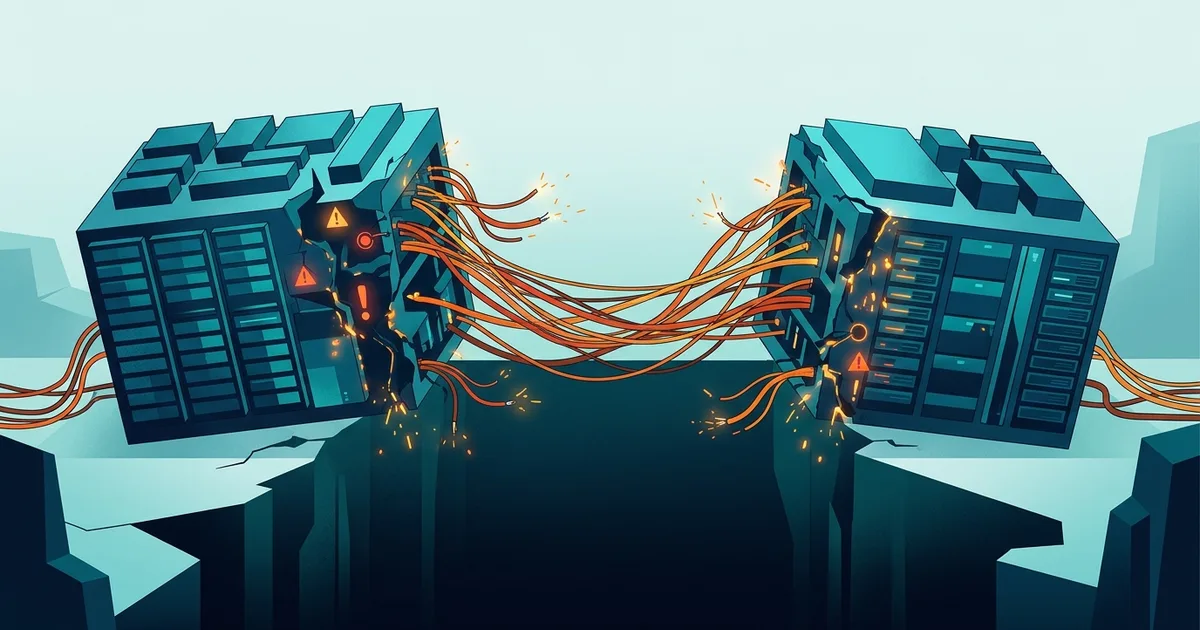
TL;DR (Direct Answer): Multi-cloud architecture splits systems across different vendors like AWS and Google Cloud to survive platform crashes. Setup sounds invincible on paper but fails in reality because cross-cloud data replication creates network lag, massive egress bills, and split-brain risks. Single cloud configured across multiple geographic regions delivers superior uptime with lower engineering overhead. Engineering teams survive disasters faster by mastering regional failover inside one ecosystem.
Two-Ticket Trap: Airline Redundancy Fallacy
Imagine traveler booking seats on two separate airlines for same business trip. Traveler buys ticket on Delta and ticket on United. Plan sounds clever: if Delta cancels flight, traveler boards United plane instead.
Reality breaks plan fast. Traveler cannot stand at two airport gates simultaneously. Luggage cannot sit in two cargo holds at once without duplicate packing. If flight delay occurs five minutes before gate closes, sprint between distant airport terminals guarantees missed flights on both sides.
Software architecture behaves identically. Companies pay double subscription fees hoping duplicate infrastructure saves uptime. Systems need synchronized customer state, active user sessions, and database writes. Duplicating compute capacity across cloud borders looks easy; synchronizing state across independent physical corporate networks breaks physics.
Technical Anatomy: Sync Lag, Egress Bills, Identity Friction
Cross-provider networks battle physical limits. Light traveling through fiber-optic cable takes time. AWS data center in Virginia pinging Google Cloud data center in Iowa adds 30 to 40 milliseconds round trip time. Every database write across both providers must wait for packet return before confirming success.
Egress costs punish distributed state. Cloud vendors let data enter networks free but charge heavy egress fees when data exits perimeter. Syncing terabytes of operational database logs across competing cloud providers drains budget fast:
[AWS us-east-1] -- Public Internet / Megaport --> [GCP us-central1]
       |                                                 |
  Egress Bill Charged                              Egress Bill Charged
  ($0.02 - $0.09 per GB)                           ($0.08 - $0.12 per GB)
Diagram shows constant tax on cross-cloud network traffic. High traffic volumes create massive surprise monthly invoices.
Identity management multiplies operational pain. Cloud providers use incompatible authentication models. AWS relies on IAM role policies; Google Cloud enforces Workload Identity pools; Azure mandates Microsoft Entra ID tenants. Engineering teams configure double authentication systems, creating security gaps that attackers exploit during confused failover events. Explore incident scenarios inside AI Playground.
Single-Cloud Multi-Region vs Multi-Cloud
Running two regions inside AWS or Google Cloud uses private, high-capacity vendor fiber backbones. Running multi-cloud relies on public internet transits or fragile cross-connect cables:
| Comparison Metric | Single Cloud (Multi-Region) | Multi-Cloud (Cross-Vendor) |
|---|---|---|
| Inter-region Latency | Low (Vendor backbone) | High (Cross-provider hops) |
| Egress Bandwidth Cost | Discounted internal rates | Full enterprise egress rates |
| IAM Complexity | Single unified model | Multiple incompatible engines |
| Failover Automation | Native DNS / Route53 / Cloud CDN | Custom middleware / Third-party DNS |
| Outage Survival Rate | High for regional failures | Poor due to state inconsistency |
Single cloud keeps configuration logic uniform. Team debugs one set of logs, one monitoring toolset, and one permission model.
Sync Lag and CAP Theorem Realities
CAP theorem states distributed computer system delivers only two out of three guarantees: Consistency, Availability, and Partition tolerance. Multi-cloud setups face frequent network partitions between separate cloud backbones:
     [Region A: AWS US-East]
                |
     === Network Split ===
                |
     [Region B: GCP US-East]
Network partition forces hard architectural choice:
- Stop accepting customer writes until cross-cloud link heals. Outage strikes both clouds immediately.
- Allow customer writes on both sides simultaneously. Database splits into divergent realities.
Choosing second path corrupts customer ledgers, inventory counts, and account balances. Healing out-of-sync databases after cross-cloud network partition requires days of manual database surgery.
Portable Container Myth and Common Denominator Trap
Sales teams preach container portability. Pitch claims Docker containers and Kubernetes clusters run identically anywhere. Developers wrap microservices in containers, expecting smooth migration between cloud providers at push of button.
Storage, database layers, and networking primitives remain cloud-bound. Application containers need managed queues, persistent block volumes, object storage, and load balancers. Standardizing on lowest common denominator forces developers to abandon proprietary managed tools like AWS DynamoDB or GCP BigQuery. Teams end up hosting self-managed databases inside raw virtual machines, dramatically increasing maintenance failure rates. Test resilience trade-offs using Interactive Engineering Simulations.
Retailer Disaster: Split-Brain Order Loss
Large e-commerce retailer configured active-active setup spanning AWS and Google Cloud for peak shopping holiday. Architect configured system so if AWS crashed, Google Cloud handled incoming shopping cart checkout requests without interruption.
Midnight traffic spike triggered transient routing issue between cloud providers. AWS nodes could not talk to Google Cloud nodes, yet both environments remained open to internet shoppers. Both clouds continued processing checkout transactions independently for same limited warehouse product inventory.
Shoppers purchased identical physical television sets in both clouds. When cross-cloud network connection restored four hours later, reconciliation service detected 8,400 duplicate sales orders for zero available inventory stock. Retailer spent three days canceling orders, issuing customer refunds, and paying credit card chargeback penalties. Redundancy design manufactured crisis single-cloud setup would have avoided.
Frequently Asked Questions (FAQ)
What makes multi-cloud failover risky for databases?
Databases require strict write ordering to prevent conflicting balances or records. Replicating transactions across different cloud vendors introduces network delay and packet loss. If connection drops between vendors, database either halts operations entirely or permits split-brain writes where both clouds accept conflicting transactions. Merging divergent databases afterward without human error or data loss remains mathematically difficult.
Is multi-cloud architecture cheaper than single cloud?
Multi-cloud setups increase costs substantially across multiple budget lines. Companies pay continuous network egress fees moving data between rival cloud networks. Operational expenses climb because engineering teams must hire specialists skilled in disparate platforms. Organizations lose enterprise volume discount pricing tiers by dividing compute spend across multiple vendors instead of consolidating consumption under single account.
Why do companies choose multi-cloud if outages happen anyway?
Companies adopt multi-cloud strategies primarily to satisfy executive procurement rules, avoid vendor lock-in fears, or meet strict regional compliance laws. Some business contracts demand secondary cloud backup for legal protection. However, executive desire for business independence clashes with operational reality. Redundancy goals backfire when system maintenance complexity exceeds internal engineering capacity during outages.
How does single cloud multi-region setup provide safety?
Single cloud platforms operate private inter-region dark fiber networks isolated from regular public internet congestion. Latency remains predictable and internal network data transfer costs stay low. Engineering teams configure automated failover using standardized access controls and identical APIs across locations. If entire primary data center burns, traffic safely routes to secondary corporate facility without architectural friction.
Can Kubernetes eliminate multi-cloud configuration pain?
Kubernetes standardizes container deployment commands, but cannot abstract underlying hardware differences. Cloud-specific software configurations remain necessary for network load balancers, persistent hard drives, and firewall routing. Engineering teams must still maintain separate security profiles and networking routes for each cloud provider. Tooling complexity multiplies operational risk instead of eliminating cross-platform maintenance duties.