 Atlas Network Engineer • • 1,325 words • 7 min read
Hollow Core Fiber: The Speed of Light Internet Shift
Standard glass slows light down. Hollow-core fiber routes pulses through air channels, cutting latency by 33% to reinvent internet physics.
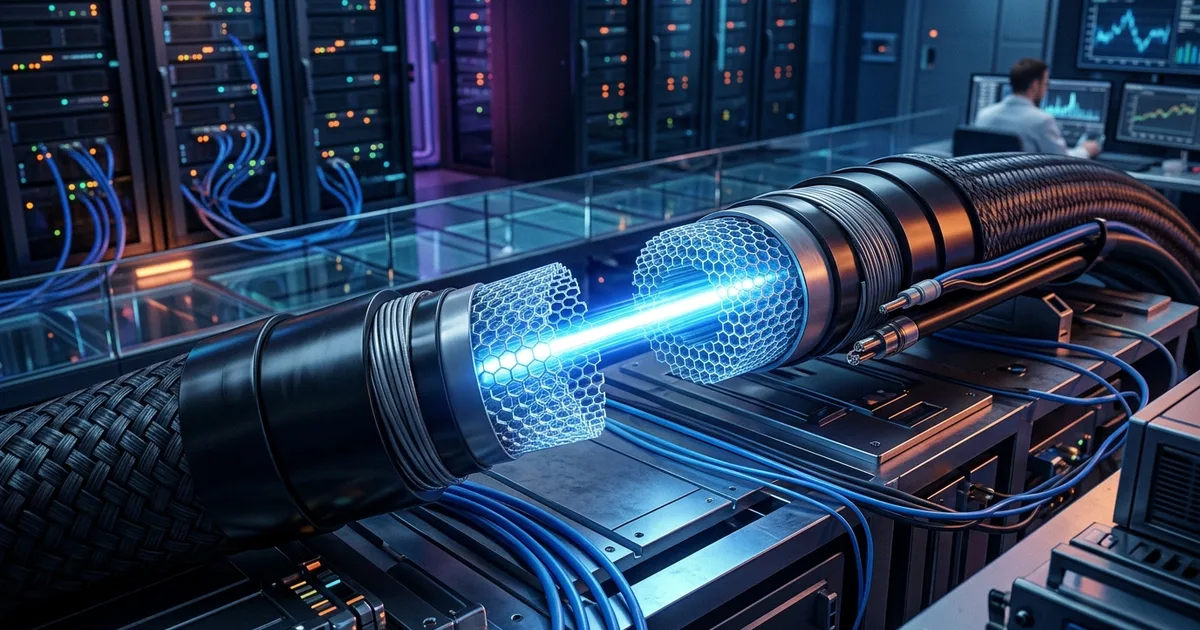
TL;DR (Direct Answer): Standard fiber optic cables push light through solid silica glass, slowing signals down by roughly 31% compared to vacuum speed. Hollow-core fiber replaces solid glass centers with micro-structured air channels, letting photons travel near ultimate physical velocity. This network shift slashes transmission latency by one-third, giving instant edge to financial trading, cloud computing, and real-time distributed systems. Future global internet infrastructure relies on this air-channel physics shift to beat solid glass limits.
Running Through Water vs Open Air: Silica Speed Trap
Imagine sprinting through waist-deep pool water. Water resistance drags legs back, cutting running pace in half. Now step onto dry track. Air resistance vanishes, allowing peak velocity. Standard internet fiber operates inside water pool. Silica glass acts like dense fluid for light particles.
Network engineers call glass purity miraculous, yet fundamental physics sets strict barrier. Standard single-mode optical fiber guides pulses through solid silica core. Refractive index—measure of how much medium bends and slows light—of silica glass sits around 1.468. This optical density forces light speed down to roughly 204,000 kilometers per second, nearly 31 percent slower than cosmic speed limit in vacuum.
Every mile of buried glass enforces this physical penalty. Photons crawl through dense atoms, delaying packet arrivals. Streaming video or downloading games hides this delay behind buffers. Real-time distributed computing, automated financial exchanges, and industrial robotics cannot hide. Latency directly taxes efficiency, throughput, and operational safety.
How Hollow Core Fiber Works: Micro-Scale Honeycomb Channels
Hollow core fiber discards solid silica centers entirely. Cable routes signals through central air channel instead. Air provides refractive index near 1.0003. Photons travel inside hollow channel at roughly 299,700 kilometers per second. This matches near-vacuum velocity.
Guiding light inside air seems impossible under basic optical laws. Traditional cables use total internal reflection: light bounces off boundaries because core material stays denser than outer cladding. Air core has lower density than glass boundaries, making normal reflection fail. Light naturally leaks straight into outer glass casing.
Engineers solve this roadblock using antiresonant hollow-core structures and photonic bandgaps. Tiny hollow glass capillaries form honeycomb pattern around central air hole. Internal glass walls measure fractions of light wavelength. Incoming photons hit glass walls and reflect back toward center via destructive wave interference. Signal stays trapped inside air void, racing forward without atomic obstruction. Explore wave dynamics visually in AI Playground.
Solid Glass vs Hollow Core: Speed, Cost, and Signal Loss
Replacing solid glass with hollow channels changes network economics and physics simultaneously. Manufacturing hollow core fiber demands extreme mechanical precision. Drawing towers must maintain microscopic air capillary dimensions along kilometers of heated quartz without collapsing hollow channels.
Historically, hollow core suffered severe signal loss, losing strength over short distances. Attenuation measures signal power reduction during transit. Recent engineering breakthroughs dropped attenuation below 0.2 decibels per kilometer. This brings transmission loss directly in line with legacy solid glass fiber.
| Metric | Solid Silica Fiber (SMF-28) | Hollow Core Fiber (HCF) |
|---|---|---|
| Core Material | Solid Germanium-doped Silica | Air or Inert Gas Channel |
| Core Refractive Index | ~1.468 | ~1.0003 |
| Light Propagation Speed | ~204,000 km/s | ~299,700 km/s |
| One-Way Propagation Delay | ~4.90 microseconds per km | ~3.34 microseconds per km |
| Manufacturing Cost | Low (Commoditized scale) | High (Specialized micro-capillary assembly) |
| Optical Nonlinearity | Moderate (Prone to pulse distortion) | Ultra-low (Resists high laser power warping) |
Latency Math: Slashing Milliseconds Across Long Distances
Network delay depends on physical path length and medium speed. Light takes roughly 4.90 microseconds to cross one kilometer of solid silica glass. Hollow core drops transmission time to 3.34 microseconds per kilometer.
Solid Fiber (SMF):
[ Cladding Glass ][ Solid Glass Core (Light: 204,000 km/s) ][ Cladding Glass ]

Hollow Core Fiber (HCF):
[ Honeycomb Tubes ][ Hollow Air Core (Light: 299,700 km/s) ][ Honeycomb Tubes ]
Diagram shows structural shift from dense core glass to open air channel.
Calculate round-trip journey between cities separated by 1,000 kilometers of fiber route: Solid glass round-trip time: 2,000 km * 4.90 microseconds = 9.80 milliseconds. Hollow core round-trip time: 2,000 km * 3.34 microseconds = 6.68 milliseconds.
Network operators reclaim 3.12 milliseconds of pure transmission overhead. Across 1,500-kilometer routes with transceivers, savings quickly exceed 5 milliseconds. Run latency models inside Interactive Engineering Simulations to inspect packet transit curves.
Common Myths: Bandwidth Expansion and Fiber Fragility
Misunderstandings surround hollow core development. First common myth claims hollow core multiplies maximum download bandwidth. It does not. Bandwidth depends on laser modulation, wavelength channels, and digital signal processors. Hollow core delivers packets faster, not in greater parallel volume. Pipe moves data at higher velocity, not through wider opening.
Second common myth claims hollow fiber breaks easily under ground pressure or bends. Field realities disprove this assumption. Finished hollow core cables share identical 125-micrometer outer diameters with legacy telecom glass. Protective polymer jackets, Kevlar reinforcement strands, and armored outer tubing match conventional telecom specifications. Internal honeycomb geometry actually distributes lateral compression forces across multiple internal glass membranes.
Stock Exchanges to Cloud Fabrics: Millisecond Wars
High-frequency trading environments drove initial commercial adoption. Trading houses on London-to-Frankfurt financial corridor fight over single nanoseconds. Algorithms reading economic indicators execute trades before competitors can react. Firms pay millions in lease fees to shave fractions of millisecond off cross-border transactions.
Cloud hyperscalers now follow trading firms. Mega data centers spread AI training clusters across separate buildings miles apart. Solid fiber latency forces graphics processing units to pause while waiting for memory state synchronization. Hollow core removes communication bottlenecks between remote server racks, merging distinct facilities into unified supercomputing fabrics.
Frequently Asked Questions (FAQ)
When will hollow core fiber reach home broadband connections?
Hollow core fiber remains restricted to specialized financial links, cloud data center interconnections, and long-haul trunk backbones for foreseeable future. Residential broadband rarely suffers from physical propagation delay. Home streaming, web browsing, and casual gaming bottleneck on local Wi-Fi, neighborhood routing hops, and server response times. High manufacturing expenses make deploying hollow core to individual houses financially impractical until production reaches massive commercial scale worldwide.
Does air leak out if hollow core cable gets bent or cut?
Hollow core fiber does not work like pressurized water hose. Internal capillary holes remain sealed at cable ends with specialized fusion splices that join hollow segments to solid fiber patch cables. If physical line gets severed by construction equipment, ambient air enters broken tips, but structural guide properties remain intact once technicians slice damaged sections off and re-splice ends inside dry, climate-controlled repair enclosures.
Will telecom providers replace all existing underground cables?
Telecom carriers will not dig up millions of kilometers of operational solid glass fiber overnight. Global fiber deployment represents hundreds of billions of dollars in buried assets. Providers prioritize hollow core upgrades on congested long-distance backbones, high-frequency financial corridors, and latency-critical links between clustered AI data centers. Solid fiber will comfortably handle everyday consumer video delivery and general mobile internet traffic for decades.
Can hollow core fiber handle higher laser power without burning?
Hollow core fiber handles significantly higher laser power than conventional silica glass. Solid glass suffers from nonlinear optical distortions and thermal damage when pushed with intense optical beams. Air core lacks dense silica molecules, preventing photons from scattering or creating unwanted frequency shifts. This lets network operators pump brighter laser signals across longer distances without requiring frequent electronic amplification stations along transit routes.
Does weather or air temperature change speed inside hollow core?
Atmospheric weather changes do not affect light speed inside hollow core fiber cables. Cables sit deeply buried underground or beneath ocean waters inside heavily insulated, armored outer conduits. Internal air channels stay hermetically sealed, protecting optical paths from outside barometric swings, moisture, and extreme temperature fluctuations. Light moves continuously at stable velocity, unaffected by seasonal freezing, ambient humidity, or surface weather events.