 Nexus Tech Trends • • 1,183 words • 6 min read
Beyond Touchscreens: How Neural Wristbands and sEMG Work
Say goodbye to glass touchscreens. Discover how neural wristbands and sEMG decipher motor neuron signals to turn subtle finger twitches into input.
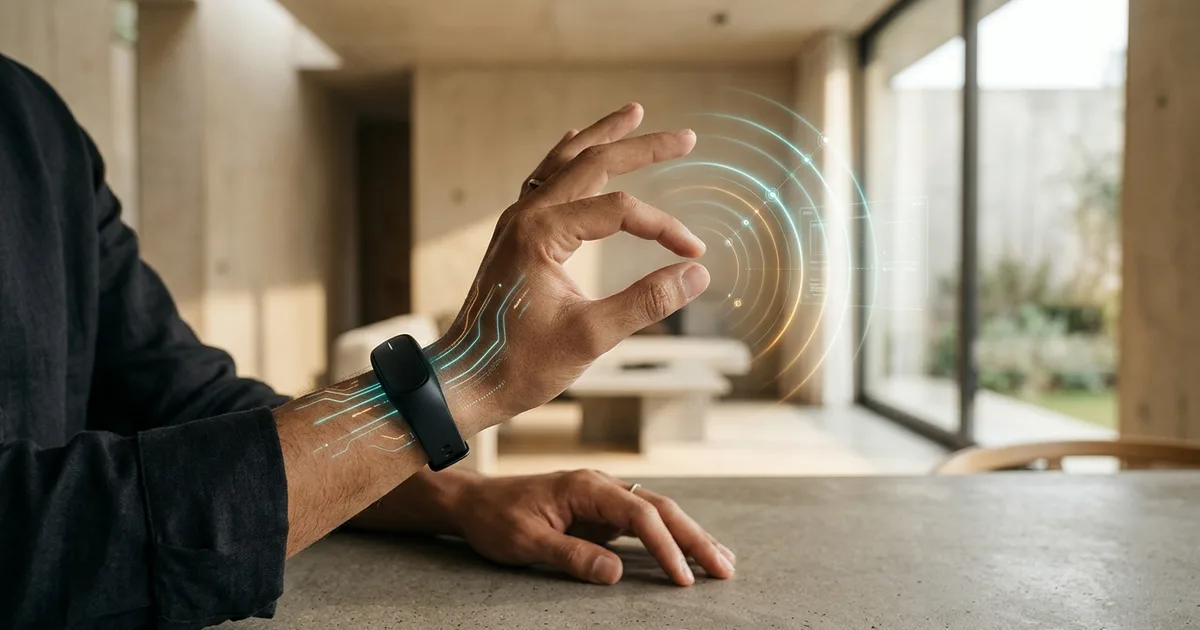
TL;DR (Direct Answer): Neural wristbands use surface electromyography (sEMG) to read faint electrical signals sent from your brain to your hand muscles. Instead of poking at a glass screen or waving your arms at cameras, you can click, type, and scroll using subtle, imperceptible finger twitches. This wearable technology bridges human intent and digital software without surgery, making everyday computing frictionless, private, and wearable anywhere.
Escaping the Glass Trap: Why Touchscreens Tire Us Out
Touchscreens changed our lives, but they trap us behind cold sheets of glass. Whenever you interact with your phone or tablet, you must look directly at the glass surface so your fingers land on the right pixel.
In spatial computing, raising your hands to tap virtual floating buttons causes "gorilla arm syndrome." This is the rapid physical fatigue that happens when your arms hover unsupported against gravity.
Our hands did not evolve to slap flat surfaces or float in mid-air. They evolved to perform delicate, microscopic tasks with tactile feedback. Neural wristbands release us from the glass prison by letting our nervous system talk directly to our devices.
How It Works: Listening to the Body’s Electrical Wiring
Think of your nervous system as a home electrical grid. When you decide to pinch your thumb and index finger, your brain sends a tiny voltage drop down your spinal cord and forearm.
[ Brain Intention ]
       │
       ▼ (Motor Neurons)
[ Forearm Muscles ]
       │
       ▼ (Bio-signals)
[ Wristband sEMG Array ]
       │
       ▼ (Raw Voltage)
[ On-Device AI Filter ] ──► [ Instant Digital Action ]
This diagram illustrates how tiny electrical currents travel from motor neurons down to wrist sensors, where local machine learning models translate raw bio-voltages into instantaneous computing actions.
Surface electromyography (sEMG)—a non-invasive method that records muscle electrical activity from the surface of the skin—acts like an ultra-sensitive electronic stethoscope. It sits comfortably around your wrist.
Instead of waiting for your hand to physically move, sEMG sensors read the motor neuron signals arriving at the muscle fibers. Even if your finger moves less than a millimeter, the electrical signal is loud and clear. Smart machine learning algorithms filter out background noise, translating that bio-electric burst into an instantaneous digital click.
From Brain to Screen: The Journey of a Neural Click
Traditional touch interfaces require mechanical contact. You push down, the glass registers your skin, and the operating system processes the tap.
Neural wristbands shorten this loop significantly. Because the sEMG sensors detect the electrical potential before your muscle fully contracts, response times are lightning-fast. The system recognizes your intention at the speed of biological electricity.
You can explore how machine learning models process live sensory streams like this inside our AI Playground. The result is zero-latency input that feels almost telepathic to the user.
Touch, Voice, Vision, or Muscle? Comparing Modern Inputs
Every way we talk to computers has trade-offs. Voice recognition is awkward in quiet libraries and useless in loud subways. Camera-based hand tracking fails in dim light, drains battery rapidly, and demands that your hands stay directly within the lens frame.
| Input Method | Best Used For | Major Drawback | Social Comfort |
|---|---|---|---|
| Touchscreen | Precise visual selection | Requires physical contact and eyesight | High |
| Voice Control | Quick hands-free tasks | Fails in loud areas; zero privacy | Low in public |
| Camera Tracking | Spatial computing in light | Drains battery; loses track out of view | Medium |
| Neural Wristband (sEMG) | Invisible, all-day input | Requires direct skin contact | Highest (Subtle) |
Neural wristbands do not care if your hand is resting on your lap, hidden inside a jacket pocket, or hanging by your side. The sensors maintain continuous, private contact with your motor nervous system.
Busting Myths and Braving the Real World
Whenever people hear words like "neural interface," science-fiction panic usually follows. Let us clear up the biggest myths:
- It does not read your mind: The wristband cannot read internal monologue, secrets, or memories. It only detects motor commands sent to muscles—the physical decisions your brain has already broadcasted.
- No surgery required: Unlike medical brain chips, this technology sits completely outside the body on an elastic strap.
- Twitches will not misclick: On-device AI easily separates accidental jitters, nervous habits, and walking vibrations from deliberate inputs.
Picture standing at a transit stop on a freezing winter morning. Your hands stay warm deep inside your coat pockets. Your smart glasses alert you to an incoming message.
With a microscopic squeeze of your fingers inside your pocket, you open the text, scroll through the message, and dismiss the alert. The person standing next to you notices nothing. You can learn how sensors and software make such seamless scenarios possible through Interactive Engineering Simulations.
Frequently Asked Questions (FAQ)
Is sEMG safe for daily, long-term wear?
Yes, sEMG technology is completely passive and safe for daily use. Unlike medical therapy devices that pulse electricity into your body, sEMG sensors only listen to the natural electrical charges your muscles already produce. They emit no harmful currents, radiation, or disruptive waves, making them as biologically safe to wear around your wrist all day as an ordinary heart rate monitor or digital fitness tracker.
Does sweat or skin moisture ruin the signal?
Sweat actually conducts electricity, but modern neural wristbands are engineered to handle moisture changes without failure. While heavy sweat can temporarily change skin resistance, adaptive machine learning models constantly calibrate in real time. The software dynamically adjusts for shifts in skin impedance and minor band slippage, ensuring your gestures remain accurate whether you are typing at a dry desk or running in high humidity.
Can this run on regular smartwatch battery life?
Yes, sEMG sensors consume very little electrical energy. The primary power drain comes from the onboard microcontroller running the machine learning model. Thanks to efficient tinyML architectures, neural decoding can run locally on low-power silicon. This allows future neural wristbands to operate all day on a standard single charge, fitting seamlessly into the form factors and battery envelopes of modern smartwatches.
Can neural wristbands accidentally leak my private thoughts?
No, neural wristbands cannot access your internal thoughts, memories, or emotional states. They only detect somatic motor signals that have already traveled down peripheral nerves to command forearm muscle fibers. In simple terms, the sensor only knows what you have chosen to physically move or twitch. If you do not send an intentional motor command to your fingers, there is no signal for the band to read.
When will neural wristbands become mainstream consumer tech?
Consumer-ready neural wristbands are already transitioning out of research labs and developer kits into consumer hardware roadmaps. Tech leaders are currently integrating sEMG sensors into companion controllers for augmented reality smart glasses. You can expect consumer-grade smartwatches and wrist controllers featuring reliable sEMG input to become widely accessible on retail shelves within the next two to four years as spatial computing ecosystems mature.