 Nexus Tech Trends • • 1,525 words • 8 min read
Silicon-Carbon Batteries: Why Phones Now Last Two Days
Silicon-carbon anodes pack 6000+ mAh into thin phones. How the chemistry works, swelling risks, cycle life, cold weather limits, and what to buy.
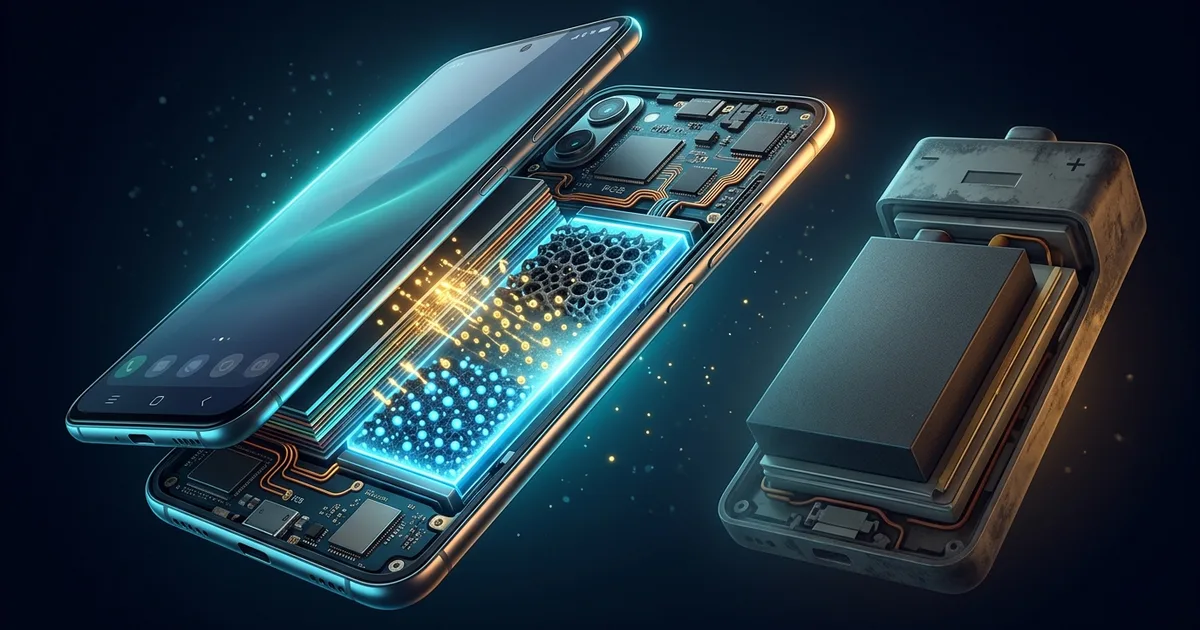
TL;DR (Direct Answer): Silicon-carbon anodes replace pure graphite, storing up to ten times more lithium ions by mass. Smart phone makers pack 6,000 mAh to 7,500 mAh capacity into ultra-thin devices without increasing hardware thickness. Nanoscale porous carbon matrix absorbs silicon swelling during charge cycles, while battery management systems preserve cell health. Users gain true two-day battery life, superior cold-weather endurance, and freedom from external power banks.
Parking Garage Analogy: Why Graphite Hit Limits
Traditional lithium-ion batteries rely on graphite anodes. Anode means negative electrode absorbing energy during charging. Think of graphite anode like parking garage with inefficient architecture. Six carbon atoms must bond together to hold single lithium ion. This structural limit caps graphite energy density at theoretical ceiling: 372 milliampere-hours per gram (mAh/g). Phone manufacturers squeezed maximum possible energy out of this chemistry decade ago.
Silicon changes garage layout completely. Single silicon atom binds directly with up to four lithium ions. This structural leap yields theoretical capacity between 3,600 and 4,200 mAh/g, roughly tenfold increase over carbon alone. Devices retain identical dimensions while internal capacity jumps from 5,000 mAh standard to 6,000 mAh or even 7,500 mAh packs. Thin phones stay sleek under eight millimeters thickness. Users browse, game, and navigate across two full days without tethering to wall outlets or hauling heavy power banks.
Explore advanced hardware concepts inside AI Playground to see how miniaturization reshapes mobile computing.
Chemical Mechanics: Taming Silicon Swelling
Battery charging follows predictable sequence inside cell chemistry:
- Charger applies voltage, pushing lithium ions from positive cathode across liquid electrolyte toward negative anode.
- Pure silicon absorbs incoming ions via alloying process, swelling up to 300 percent past original physical volume.
- Uncontrolled expansion cracks silicon particles, severing electrical pathways and destroying battery capacity within dozens of cycles.
- Engineers resolve mechanical breakdown by embedding nano-sized silicon particles inside flexible, porous carbon sponge.
- Porous carbon architecture cushions internal volumetric expansion without expanding outer pouch dimensions.
- Solid electrolyte interphase (SEI)—protective chemical coating forming on anode surface during initial charge—remains stable across carbon exterior instead of repeatedly tearing apart on raw silicon surfaces.
Commercial smartphone batteries currently mix between 6 and 15 percent silicon into conventional graphite. Pure silicon provides extreme capacity, yet high concentrations degrade cycle retention too rapidly for consumer standards. Hybrid ratio delivers 15 to 25 percent overall density gains while maintaining standard multi-year longevity.
Anode Chemistries Compared: Graphite to Solid-State
Graphite anodes dominate electronics industry because manufacturing costs remain low and production lines run reliably. Graphite withstands 800 to 1,000 full recharge cycles easily, but chemical physics prevents further energy increases.
Silicon-carbon composites offer viable immediate upgrade path. Blended anodes boost volumetric energy density by 15 to 25 percent inside identical dimensions. Trade-offs include higher raw material expense, slightly elevated initial capacity loss during formation cycling, and tighter voltage management demands placed upon internal battery management system (BMS).
Silicon-dominant technologies engineered by startups like Sila Nanotechnologies, Group14 Technologies, and Amprius push silicon content toward maximum limits. These reach stellar energy metrics but face shortened cycle lifespans or high production costs limiting them to specialized hardware.
Solid-state batteries replace flammable liquid electrolytes with solid ceramics or polymers, promising non-flammable operation alongside massive density. However, manufacturing challenges keep true solid-state cells confined to pilot research laboratories. Phone consumers should look toward silicon-carbon today rather than holding out for distant solid-state promises.
| Anode Technology | Usable Energy Density | Cycle Life (to 80% Health) | Relative Unit Cost | Market Availability |
|---|---|---|---|---|
| Standard Graphite | 240–260 Wh/kg | 800–1,200 cycles | Low | Everywhere (mature) |
| Silicon-Carbon (6–15% Si) | 280–340 Wh/kg | 800–1,000 cycles | Moderate | High-end phones today |
| Pure / Dominant Silicon | 400–500 Wh/kg | 300–600 cycles | High | Niche devices, drones |
| Solid-State (Lab Cells) | 400–500+ Wh/kg | 1,000+ cycles (projected) | Extreme | Lab testing only (2030+) |
Reading Battery Specs and Diagnostic Verification
Manufacturer spec sheets frequently hide battery evolution behind marketing jargon. Look for designations such as "Si-C", "silicon-carbon", or "silicon-doped anode". Always prioritize watt-hours (Wh) over milliampere-hours (mAh) when evaluating runtime capacity. Calculate watt-hours directly:
$$\text{Wh} = \frac{\text{mAh} \times \text{Nominal Voltage}}{1000}$$
Comparing Wh prevents deception caused by varying operating voltages across multi-cell battery packs. Examine structural difference across anode materials:
GRAPHITE ANODE:                SILICON-CARBON ANODE:
[C] [C] [C] [C] [C] [C]        +----------------------------+
       |                       |  Porous Carbon Sponge      |
     [Li+]                     |   [Si Nano] <== 4x [Li+]   |
(6 Carbon atoms hold 1 Ion)    |   (Void space traps swell) |
                               +----------------------------+
Diagram contrasts flat graphite sheets trapping single ion against porous carbon matrix shielding expanding silicon nanoparticles.
Users inspect battery operating parameters directly via Android Debug Bridge (ADB):
adb shell dumpsys battery
Command reads raw hardware values including current charge level, battery temperature, charge counter, and real-time millivolts.
Test custom energy calculations through Interactive Engineering Simulations to understand real-world battery discharge profiles.
Battery Myths: Swelling, Degradation, and Safety
Several misconceptions distort discussions surrounding modern silicon battery integration:
- Myth: Higher mAh rating guarantees longer operational life. False. Power consumption depends primarily upon system-on-chip (SoC) microarchitecture, display panel efficiency, and software background tasks. Unoptimized operating system drains 6,500 mAh battery faster than efficient device depletes 5,000 mAh cell.
- Myth: Silicon batteries swell outwards and rupture. False. Volumetric expansion occurs at microscopic level inside engineered nanoscale pores. External battery pouch remains flat throughout lifecycle because surrounding carbon lattice traps physical deformation.
- Myth: Fast charging degrades silicon-carbon instantly. Partly false. Heat degrades battery health regardless of chemistry. Modern silicon-carbon flagships use dual-cell designs and multi-sensor BMS monitoring to regulate thermal loads during 80W or 100W charging sessions.
Consumer mistakes involve misreading air travel regulations. Global aviation authorities enforce 100 watt-hour maximum restrictions on carry-on lithium power banks without prior airline approval. High-capacity silicon power banks store vastly more energy within pocket-sized cases, yet travelers must verify rated Wh printed on casing before entering airport security.
Industry Timeline: Wearables to Electric Vehicles
Commercial battery evolution always begins in low-risk wearables before expanding into high-volume smartphones and heavy vehicles. Sila Nanotechnologies achieved milestone commercial deployment in 2021 by providing Titan Silicon anodes for WHOOP 4.0 fitness tracker. Novel material enabled 33 percent size reduction without sacrificing five-day runtime.
Smartphone deployment erupted across Asian markets soon afterward. Honor introduced first commercial smartphone silicon-carbon battery inside Magic5 Pro in 2023. Competitors like OnePlus, Xiaomi, and vivo rapidly adopted enhanced chemistries, releasing devices carrying 6,000 mAh to 7,500 mAh capacities inside profiles under 8.5 millimeters thick.
Apple and Samsung adopt conservative approach toward new anode mixtures. Global supply chain constraints, strict multi-year reliability testing, and stringent European Union battery replacement directives force industry giants toward prolonged validation periods. Hardware development follows clear hierarchy: wearable sensors validate material stability first, smartphones scale manufacturing volume second, and electric vehicles adopt chemistries once cost curves drop significantly.
Frequently Asked Questions (FAQ)
Does silicon-carbon battery last fewer years than regular one?
No. Current silicon-carbon smartphone cells deliver 800 to 1,000 complete charging cycles before capacity drops to 80 percent original volume. This matches traditional graphite performance. Modern devices blend only 6 to 15 percent silicon into porous carbon matrices, avoiding mechanical fragmentation that plagued early pure-silicon prototypes. Smartphone owners experience roughly three to four years of consistent daily use before noticing substantial battery degradation.
Is it safe to fast charge every night?
Yes, overnight fast charging remains safe when using OEM chargers. Modern smartphones communicate continuously with charging bricks, throttling current as battery temperature rises or charge levels pass 80 percent threshold. Built-in battery management systems prevent lithium plating and thermal stress. Enabling software settings like optimized night charging delays final 20 percent charge until right before morning wake-up routines, protecting silicon-carbon anode integrity across years.
Does it perform worse in cold weather?
No, silicon-carbon delivers superior low-temperature performance compared against standard graphite. Graphite suffers severe internal resistance jumps below freezing, causing sudden phone shutdowns. Silicon retains higher lithium diffusivity at low temperatures, enabling stable voltage output even during sub-zero exposure. Users in winter conditions observe reliable camera operation and normal runtime under conditions where older phones freeze, discharge prematurely, or unexpectedly switch off.
Can old phone battery be replaced with Si-C pack?
No. Silicon-carbon battery cells require dedicated charge controllers and customized firmware voltage tables. Silicon changes cell discharge voltage curves throughout active usage cycles. Installing aftermarket silicon-carbon pack into phone designed purely for graphite creates inaccurate battery percentage readings, improper charging cutoffs, and potential thermal runaways. Replacement batteries must strictly match original chemistry and manufacturer engineering specifications embedded into device hardware.
When will laptops and electric cars get same jump?
Electric vehicles and laptops already begin integrating silicon-carbon cells. Mercedes-Benz partnered with Sila Nanotechnologies to deploy silicon-dominant anodes inside electric G-Class luxury models. Laptops will adopt high-silicon cells within coming hardware refresh cycles as pouch production scales up. However, automotive verification processes require five to seven years of exhaustive thermal and crash validation, slowing consumer rollouts compared against rapid twelve-month smartphone upgrade schedules.