 Nexus Tech Trends • • 1,155 words • 6 min read
AI Detector Myth: Why Text Checkers Flag Innocent Writers
Why AI text detectors wrongly flag students and non-native writers: perplexity, burstiness, watermarks, false positives and how to prove your work.
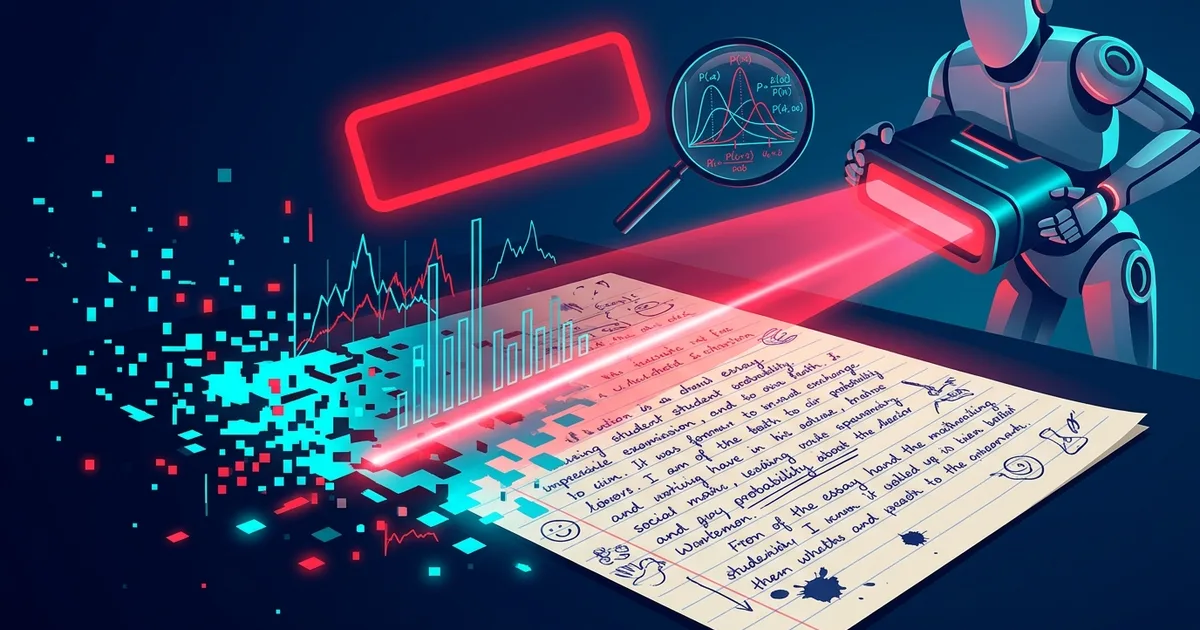
TL;DR (Direct Answer): AI text detectors don't detect AI. They guess based on how predictable and how uniform your writing looks. Clean, formal, or non-native English often looks "predictable," so innocent writers get flagged while edited AI text slips through. If you're accused, your strongest defense is your document's version history, not a counter-score.
The Airport Lie Detector Problem
Picture an airport lie detector. It measures sweat and heart rate, not truth. A nervous honest traveler fails, and a calm liar passes. AI detectors work the same way. They measure writing signals, not authorship.
A student writes an essay alone at 2 a.m., and the tool says "98% AI." Now a grade, a scholarship, or a reputation is on the line, based on a statistical hunch.
This matters to more people than you might think. Students face misconduct hearings. Teachers risk punishing honest kids. Freelancers lose clients who run their copy through free checkers. Parents end up arguing with schools over a number nobody can explain.
How AI Detectors Actually Work
Think of a weather forecaster. A forecaster predicts tomorrow's weather without knowing it for certain. Detectors do the same with words.
- Tokens. Your text is chopped into tokens, which are small chunks of words.
- Prediction. A reference language model (an AI trained to guess the next word) predicts each token.
- Perplexity. Perplexity measures how surprised the model is by each word. Low surprise counts as "looks like AI."
- Burstiness. Burstiness measures how much your sentence length varies. Uniform sentences count as "looks like AI."
- Verdict. A classifier turns those scores into a confident-looking percentage.
 Your text ──► [Perplexity meter: LOW ]──┐
                                         ├──► Verdict: "92% AI"
           ──► [Burstiness meter: FLAT]──┘
The diagram shows two style measurements being combined into one score. Neither of them checks who wrote the text.
The key point: plain text carries no hidden fingerprint. The output is a probability guess, not proof.
Comparing Detection Options
Not all tools are equally shaky. Here's how the main approaches compare.
| Approach | Example | Good at | Bad at |
|---|---|---|---|
| Statistical detector | GPTZero-style | Cheap, fast | Easy to fool, many false positives |
| Trained classifier | Turnitin-style | Long, unedited text | Short or edited text |
| Watermarking | Google DeepMind SynthID Text (open-sourced Oct 2024) | Reliable if the model maker embeds it | Only works on cooperating models; breaks under paraphrase or translation |
| Provenance | Google Docs version history, draft logs | Shows the actual writing process | Takes effort to keep |
A watermark works like an invisible ink pattern in word choices. It only exists if the AI company put it there. Provenance is boring, but it is the strongest evidence available.
One Paragraph, Three Verdicts and Five Myths
Here is the same idea written three ways:
- Formal, textbook-style human writing: flagged as "AI." It's smooth and predictable.
- Raw ChatGPT output: flagged as "AI."
- That same ChatGPT output after a paraphraser: rated "human."
Swap a single common word for an unusual one, and perplexity jumps. That one change can flip the verdict. You can explore similar cause-and-effect behavior in our AI Playground.
Myths that need to die
- "99% means 99% sure." No. Vendors rarely publish calibration, which is proof that their numbers match reality.
- "Ask ChatGPT if it wrote this." No. The model has no memory of its past outputs and will claim anything.
- "Good writers never get flagged." It's the opposite. Clean, formal, and non-native English gets flagged most.
- "Watermarks catch everything." They only catch text from cooperating models, and only if it hasn't been edited.
- "Detectors improve as AI improves." The arms race favors the generators.
Real-World Fallout
In July 2023, OpenAI shut down its own AI Text Classifier for low accuracy. It caught only 26% of AI text and wrongly flagged 9% of human text. If the company that built ChatGPT can't reliably detect it, a free web tool can't either.
A Stanford study (Liang et al., 2023) found that detectors labeled more than half of TOEFL essays written by non-native English speakers as AI-generated.
In May 2023, a Texas A&M University-Commerce instructor pasted student essays into ChatGPT, asked whether it wrote them, and threatened the whole class with failing grades. Students were cleared using Google Docs timestamps.
For hands-on intuition about how models behave under the hood, try our Interactive Engineering Simulations.
Frequently Asked Questions (FAQ)
Can any tool prove text is AI-written?
No. Plain text carries no built-in fingerprint, so detectors can only estimate probability from style signals like perplexity and burstiness. Watermarking comes closest, but it works only if the AI company embedded a watermark and the text stayed unedited. Even OpenAI retired its own classifier for poor accuracy. Treat any detector score as a weak hint that calls for a conversation. It should never be treated as evidence that settles a case.
What evidence should I collect if I'm wrongly accused?
Start with version history from Google Docs, Microsoft Word, or Notion, which shows your text growing over time. Add early drafts, handwritten notes, outlines, research bookmarks, and browser history showing your sources. Save emails or chats where you discussed the topic. Export everything with timestamps before anything gets overwritten. Then ask, in writing, which tool was used and what its published error rate is. Process evidence beats percentages.
Why do non-native writers and neurodivergent students get flagged more?
Non-native writers often use common vocabulary and safe, textbook grammar. That lowers perplexity, which detectors read as "AI-like." Some neurodivergent writers favor consistent structure, repeated phrasing, or very formal tone, which flattens burstiness. In both cases, the tool punishes a style, not cheating. The Stanford study found that more than half of TOEFL essays were misflagged. That makes detector use an equity issue, not just a technical one.
Will watermarking become mandatory, for example under the EU AI Act?
Partly. The EU AI Act's transparency rules require providers of generative AI to mark their outputs in a machine-readable way, with obligations phasing in from 2026. That pushes companies toward watermarks like SynthID. The limits remain, though. Open-source and non-EU models may not comply, and paraphrasing or translation can strip the marks. Watermarking will help flag unedited output from major vendors. It won't become a universal AI lie detector.
What should teachers use instead of AI detectors?
Assess the process, not just the final product. Short oral defenses, where students explain their argument in their own words, reveal understanding quickly. In-class drafting sessions create verified writing samples. Process-based grading rewards outlines, drafts, and revision notes submitted along the way. Asking students to share document version history makes honesty easy to show. These methods take more effort than pasting text into a checker, but they are fair and accurate.