 Echo Support / SRE • • 1,220 words • 7 min read
When Cell Towers Fail: Your Phone Now Talks to Satellites
How does your phone text via satellite when towers go dark in earthquakes or blackouts? Direct-to-cell tech, emergency SOS and its real limits explained.
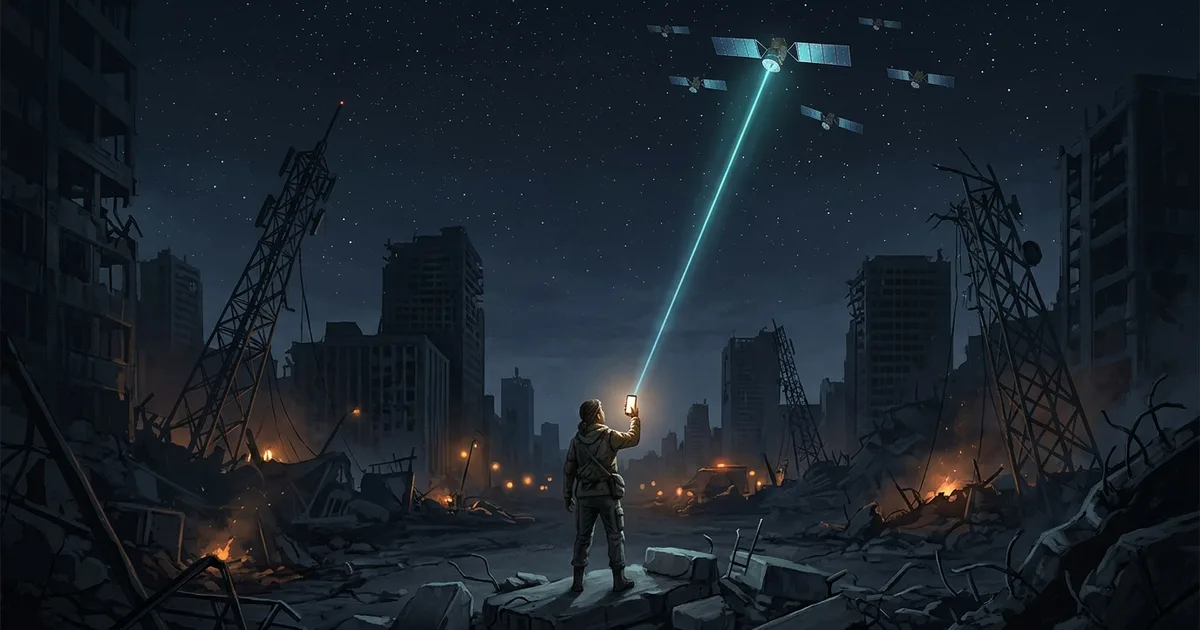
TL;DR (Direct Answer): Direct-to-cell satellite technology lets an ordinary smartphone send texts to satellites passing overhead when cell towers are down. It is designed for disasters like earthquakes, hurricanes and long blackouts. It needs open sky, it is slow, and it only works on certain phones in certain countries. For texting "I'm okay" or calling for help, it can be a lifeline.
Why "No Service" Is the Scariest Message on Your Phone
Picture a 2am earthquake. The power goes out, and nearby cell towers switch to backup batteries. A few hours later those batteries run dry and the towers go silent. Your phone shows "No Service" at the exact moment you need to tell your family you're alive.
Think of a cell tower as a lighthouse. Your phone is a boat that steers by its light. When the lighthouse goes dark, you're lost. Satellite messaging turns your phone into a walkie-talkie that can suddenly shout to the sky.
This matters to everyone, but especially in earthquake-prone countries like Türkiye. Reliable satellite communication (in Turkish, uydu iletişimi) is now a core part of disaster resilience (afet dayanıklılığı), the ability of systems and people to keep working when everything else breaks.
How Your Phone Talks to Space, Step by Step
- Low-flying satellites. LEO (Low Earth Orbit) satellites fly just 300–550 km up, at roughly 27,000 km/h. Being close keeps the signal from fading too much.
- Giant ears. Your phone's signal is a whisper. Some satellites carry phased-array antennas nearly the size of a tennis court. A phased array is a grid of tiny antennas that work together to "point" at one spot electronically.
- A tower in the sky. With direct-to-cell, the satellite acts like a regular tower, using your operator's licensed frequencies. Your phone barely notices the difference.
- Fixing motion problems. A passing satellite shifts the signal's pitch, like an ambulance siren changing tone as it drives by. This is the Doppler shift. The satellite also corrects for the delay of a long trip through space.
- Back to Earth. Messages travel down to a ground station, sometimes hopping between satellites first via laser links.
Text arrives first because it is tiny. Voice and video need far more bandwidth, so they come later.
Comparing Your Options
| Option | Cost | Device needed | Speed | Open sky? | Subscription |
|---|---|---|---|---|---|
| Satellite phones (Iridium, Thuraya) | High | Special phone | Voice + slow data | Yes | Yes |
| Built-in SOS (Apple, Android) | Free trial, then varies | Recent iPhone, Pixel, Galaxy | Texts in ~1 min | Yes | Sometimes |
| Direct-to-cell (Starlink/T-Mobile, AST SpaceMobile, Skylo) | Operator plan | Many normal phones | Texts first | Yes | Through operator |
| Messengers (Garmin inReach) | Medium | Small extra gadget | Texts + tracking | Yes | Yes |
What this means for you: Hikers and sailors may want a dedicated device. Most city dwellers just need to know whether their own phone already supports satellite messaging.
Practical Drill: Practice Before the Disaster
[Your phone] ))) [Satellite] ))) [Ground station] --> [Operator core] --> [Your family]
This diagram shows your text bouncing up to space, down to Earth, and onto the normal network.
The Satellite Text Drill
- Open demo mode. On iPhone, go to Settings → Emergency SOS → "Try Demo". Recent Android phones include a similar test under their satellite SOS settings.
- Aim at the sky. Go outside and hold the phone loosely. Follow the on-screen arrow as the satellite moves.
- Be patient. Waiting 30 seconds to a few minutes is normal.
A Short Emergency Template
"Location: [street/landmark]. 3 people. 1 injured leg. Need water and rescue." Short messages send faster.
Want to see how systems behave under stress? Try our Interactive Engineering Simulations.
Myths, Limits, and Real Rescues
Common Myths
- "It works indoors." No. Roofs and walls block the signal, so you need open sky.
- "I'll watch YouTube." No. Bandwidth is just a few kbps (kilobits per second), which is enough for text only.
- "Any phone works." Support depends on your phone model, your operator and your country's rules.
- "It's free forever." Many offers are trials that later need a subscription.
- "My battery will last." Searching for satellites drains power fast. Keep a power bank.
Why Your Country May Not Have It Yet
Satellites use radio frequencies that governments license. Until regulators approve the service, it stays switched off.
Real-World Stories
After Hurricane Helene in 2024, regulators let Starlink and T-Mobile switch on emergency satellite texting in North Carolina. iPhone satellite SOS has helped rescue stranded hikers and crash victims in remote canyons.
During the February 2023 Kahramanmaraş earthquakes, networks collapsed within hours. Satellite texting could have turned many silent nights into a single message: "We're alive."
Frequently Asked Questions (FAQ)
Does my phone support satellite messaging and how do I check?
iPhone 14 and newer support Emergency SOS via satellite in supported countries. Google Pixel 9 and newer, and Samsung Galaxy S25 models, offer Satellite SOS in selected regions. Check your phone's settings for "Satellite" or "Emergency SOS." Direct-to-cell services also depend on your operator. Ask your carrier whether they have a satellite partner and whether your plan includes it. If you see a demo option, your phone is ready to practice.
Can I use this in Türkiye and when will it arrive?
As of now, built-in satellite SOS is not officially active in Türkiye. It needs approval from the national regulator for frequencies and emergency routing, plus agreements between operators and satellite companies. Turkish operators have shown interest in direct-to-cell partnerships, but no firm public launch date exists yet. Follow announcements from your operator and the regulator. In the meantime, a dedicated device like Garmin inReach is one option, subject to local rules.
Will voice calls and internet over satellite become possible?
Yes, gradually. Text came first because it needs very little bandwidth. Companies like AST SpaceMobile and Starlink are testing voice and basic data with bigger satellite antennas. Expect slow web browsing and messaging apps before smooth video. Coverage will improve as more satellites launch. For now, treat satellite texting as an emergency tool rather than a replacement for your normal mobile network or home internet.
Is my message private and who can read it?
It depends on the service. Apple says regular messages sent via satellite keep their end-to-end encryption. That means only you and the recipient can read them. Emergency SOS messages, however, go to emergency services or relay centers so responders can help you. Operator-based direct-to-cell texts generally follow normal SMS privacy rules. Avoid sending sensitive personal details unless they are needed for your rescue.
Do these satellites cause light pollution in the night sky, and what do astronomers say?
Large satellites can reflect sunlight and leave streaks in telescope images. Astronomers have raised real concerns, especially about big direct-to-cell antennas that look bright. Companies are testing darker coatings and adjusting satellite orientation to reduce glare. Groups like the International Astronomical Union are pushing for brightness limits. Life-saving connectivity and dark skies are both worth protecting. Explore more tech trade-offs in our AI Playground.