 Echo Support / SRE • • 1,291 words • 7 min read
Your Phone Is a Seismometer: How Earthquake Early Warning Works
How earthquake early warning works: P-waves, Android phone accelerometers, cell broadcast alerts and the 2023 Türkiye lesson on winning precious seconds.
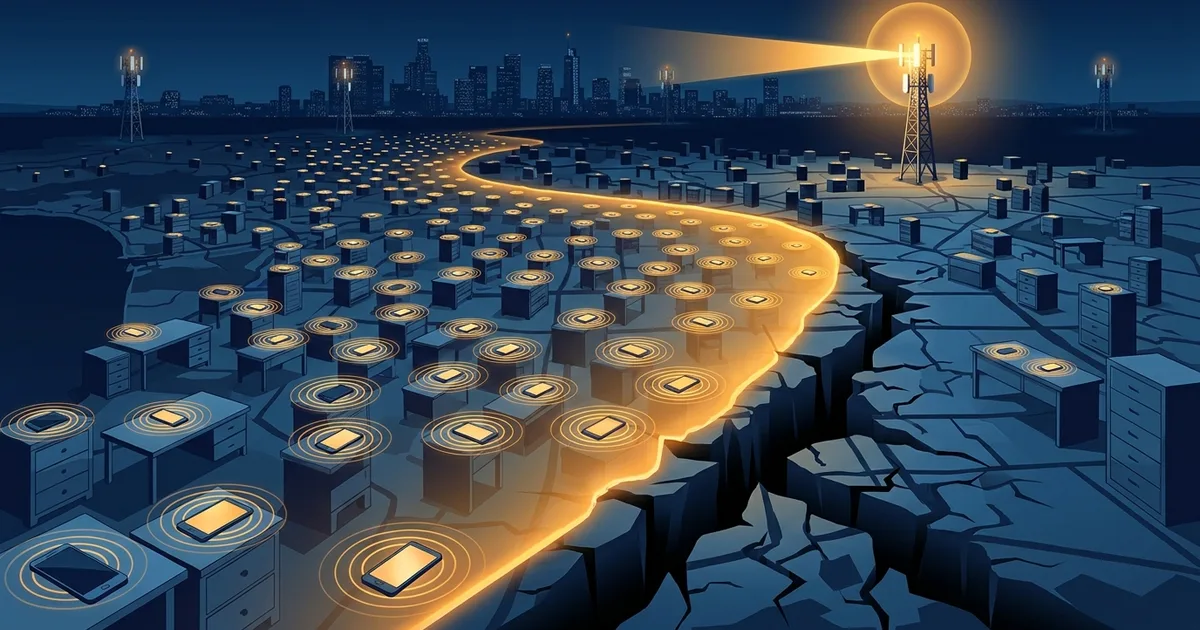
TL;DR (Direct Answer): Earthquake early warning detects an earthquake that has already started and warns people before the strongest shaking reaches them. It works because the first seismic waves are fast and harmless, while the damaging waves arrive seconds later. Today, millions of Android phones act as tiny earthquake sensors, and alerts can reach you even when your phone is on silent. Those few seconds are enough to drop, cover, and hold on.
Why Seconds Matter: Lightning Before Thunder
Think of a thunderstorm. You see the lightning first and hear the thunder later, because light travels faster than sound. Earthquakes work the same way.
Every quake sends out two main wave types. The P-wave (primary wave) is a fast push-pull wave moving about 6–7 km per second. It rarely causes damage. The S-wave (secondary wave) is a slower side-to-side wave moving about 3.5 km per second. It shakes buildings apart.
The gap between them ranges from a few seconds to tens of seconds. That is enough time to get under a table, stop a train, pause a surgery, or shut a gas valve. The phone in your pocket is now part of this race.
How Earthquake Early Warning Works, Step by Step
An early warning system works like a neighborhood watch that shouts down the street faster than the danger can travel.
The five steps
- Sensors detect the first shaking. They catch the P-wave.
- Servers confirm and estimate. Computers check that many sensors agree, so one dropped phone does not trigger an alarm. Then they estimate the location and magnitude (the quake's size).
- The system predicts impact. It calculates who will feel strong shaking, and when.
- The alert goes out. It is sent to phones in the affected area.
- Your phone takes over the screen. A loud, full-screen warning appears, even in silent mode.
Two kinds of sensors
Seismometers are professional instruments that measure ground motion with high precision. Accelerometers are the small motion chips in phones that rotate your screen. Android phones report shaking only while they are charging and lying still, which filters out walking and pocket noise.
Comparing Warning Systems and Delivery Channels
Detection is half the job. Delivery is the other half. Cell broadcast works like a radio station on cell towers: one message reaches every phone in range at once, with no app and no internet needed.
| Option | How it works | Strength | Weakness |
|---|---|---|---|
| Android Earthquake Alerts System | Millions of phone sensors | Huge coverage, low cost | Weaker size estimates for giant quakes |
| USGS ShakeAlert / Japan JMA EEW | Dedicated seismometer networks | Accurate | Expensive, limited coverage |
| Cell broadcast | One message from towers to all phones | No app needed, survives network jams | Requires carrier and government setup |
| SMS | One message per phone | Works on old phones | Messages queue up and arrive late |
| App push notification | Sent through app servers and internet | Easy to build | Fails if internet or servers overload |
Want to see how systems behave under sudden load? Try the Interactive Engineering Simulations.
What It Means for Your Phone: Timing and Settings
Here is a simple timeline for one alert:
t=0s        t=1s          t=3-5s          t=6s          t=7s
EPICENTER ---- SENSORS ---- SERVERS ---- CELL TOWER ---- PHONE
rupture      P-wave        confirm and     broadcast     full-screen
starts       detected      estimate size   sent          alert
This shows that about seven seconds pass between the start of the rupture and the alert on your screen.
Now apply distance. The S-wave reaches a city 40 km away after about 11 seconds, so people there get roughly 4 seconds of warning. A city 100 km away gets about 21 seconds. Anyone within roughly 25 km may get no warning at all. This area is called the blind zone: the shaking arrives before the alert can.
Check your settings
- Android:
Settings > Safety & emergency > Earthquake alerts - iPhone:
Settings > Notifications > Government Alerts
Check both once and keep them on. Curious how sensor networks reach agreement? Explore more in the AI Playground.
Myths and the 2023 Türkiye Lesson
Common myths
- "It predicts earthquakes." It does not. It detects one that has already started.
- "No warning means it failed." In the blind zone, physics wins.
- "Silent mode blocks alerts." High-priority alerts override it.
- "It needs internet." Cell broadcast does not.
- "A store app is the same." Third-party apps depend on push servers that can lag or overload.
What happened on 6 February 2023
The magnitude 7.8 Kahramanmaraş earthquake struck before dawn. Google later admitted its Android system badly underestimated the first quake, estimating magnitude 4.5–4.9. As a result, only 469 strongest "Take Action" alerts went out instead of about 10 million. Around 500,000 people received a weaker "Be Aware" notice.
The lessons:
- Phone-based detection can saturate on giant ruptures. Like a microphone at a rock concert, it hits its limit and misreads the size.
- Size estimates must keep updating while the fault is still breaking.
- Redundancy matters. National seismic networks plus cell broadcast provide a backup layer.
Frequently Asked Questions (FAQ)
How many seconds of warning can I expect?
Warning time depends on your distance from the epicenter, the point where the quake starts. People within about 25 km may get no warning, because strong shaking arrives before any alert can. At 40 km, expect about 4 seconds. At 100 km, expect about 20 seconds. As a rough rule, each extra 8 km of distance adds about one second of warning, after the few seconds the system spends detecting and confirming the quake.
Does my phone drain battery acting as a sensor?
No meaningful drain. Android phones contribute sensor data only while they are plugged in and lying still, usually overnight on a charger. In that state, the accelerometer is already running and power comes from the wall, so the battery is not affected. When you pick up the phone or unplug it, it stops reporting. Your daily battery life stays the same whether or not your phone helps detect earthquakes.
Is my location or data shared?
Android sends only what detection needs: a signal that shaking occurred and a coarse location, roughly the size of a neighborhood, not your exact address. Google states that this data is not tied to your identity. Cell broadcast alerts work in the opposite direction: towers send one message to every phone in range, and your phone sends nothing back. For full details, check the location and privacy settings on your device.
Why did my neighbor get the alert and I did not?
Several reasons are possible. Your alert setting may be off, or your phone may be in a mode that blocks emergency alerts. You may be connected to a different carrier or tower that did not broadcast the message. The system may have predicted only light shaking at your spot and sent no alert, or a weaker notice that was easy to miss. Check your settings, update your phone, and test alerts when possible.
What should I do in those first seconds after an alert?
Drop, cover, and hold on. Drop to your hands and knees so the shaking cannot knock you over. Cover your head and neck under a sturdy table or desk, or next to an interior wall away from windows. Hold on until the shaking stops. Do not run outside during shaking, because falling glass and debris cause many injuries. If you are driving, slow down, pull over, and stay inside the car.