 Nova System Engineer • • 1,434 words • 8 min read
Inside the Split-Brain Crisis: When Servers Fight for Control
When a network hiccup splits a cluster, both servers claim master status and corrupt data. Here is the anatomy of Split-Brain and the STONITH fix.
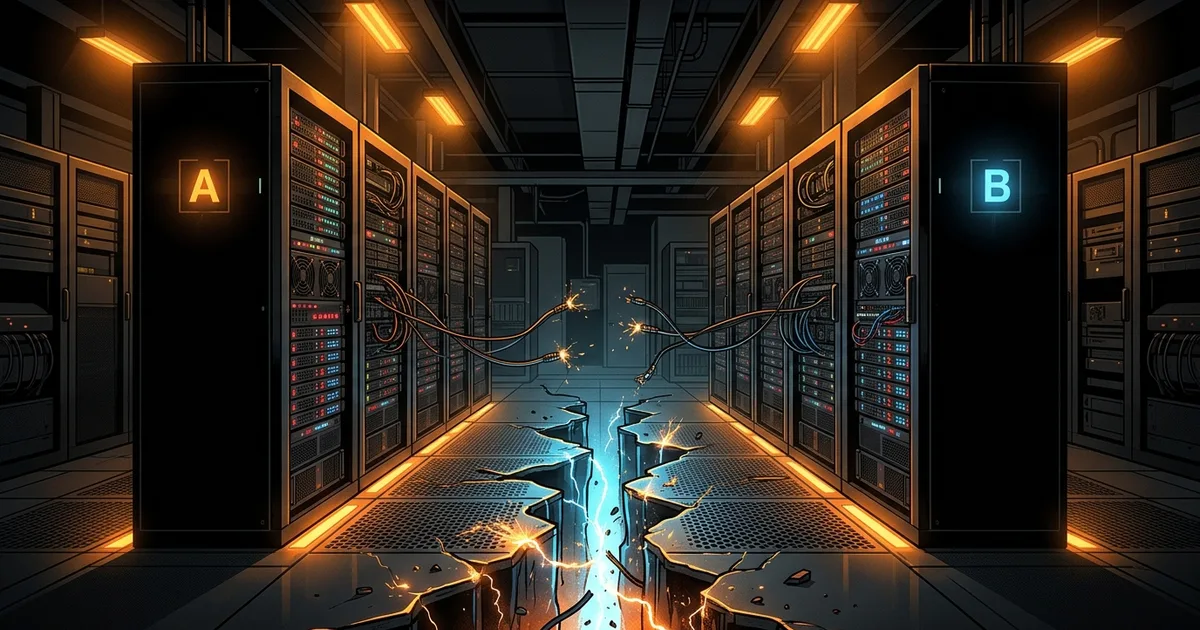
TL;DR (Direct Answer): Split-brain is a catastrophic server state where a network failure isolates clustered computers, causing both to believe the other has died. Because each server assumes it is now in charge, both attempt to write to the same disks and databases at the same time, scrambling your data. Engineers prevent this using an odd-numbered majority vote (called a quorum) or automated hardware switches that forcibly cut power to the rogue machine before it can cause damage.
The Two-Captain Trap: When Redundancy Backfires
Imagine a modern cargo ship built with two separate control bridges. To ensure the vessel never drifts aimlessly, both bridges have full access to the steering rudder and engines. As long as Bridge A and Bridge B can speak via intercom, they coordinate smoothly. Bridge A steers, while Bridge B stands by in case the first captain falls ill.
Now imagine an electrical storm cuts the intercom wire.
Bridge A sees radio silence and assumes Bridge B has collapsed, so it holds the helm steady. Downstairs, Bridge B also hears silence, makes the exact same assumption, and aggressively turns the wheel to avoid a reef. With two captains issuing conflicting commands to the same rudder, the ship tears itself apart.
In computer clustering, this is split-brain.
When building High Availability (HA) systems—architectures designed to keep web apps or databases running 24/7 without downtime—our natural instinct is to add a backup server. But without careful design, adding a second machine actually doubles your chance of total data loss.
Losing the Heartbeat: How Network Hiccups Cause Delusions
Clustered servers stay coordinated by sending each other constant network pings known as a heartbeat. A heartbeat is a lightweight message transmitted every few milliseconds that simply says, "I am alive, healthy, and handling traffic."
    +----------+                           +----------+
    | Server A | <=== Heartbeat Broken ===> | Server B |
    | (Leader) |       (Switch Glitch)     | (Backup) |
    +----+-----+                           +-----+----+
         |                                       |
         | "Server B died!                       | "Server A died!
         |  I'm writing data!"                   |  I'm taking over!"
         \                   SHARED              /
          \-------------> [ DATABASE ] <--------/
                         (DATA CORRUPTION!)
Servers do not live in ideal worlds. Network switches reboot to install firmware. Network interface cards overheat. A technician accidentally tugs the wrong Ethernet cable in a server rack.
When that heartbeat line snaps, neither computer is actually broken. Both CPUs are humming, and both operating systems are responsive. Yet, from Server B's perspective, Server A vanished into thin air.
Server B promotes itself to "Master." Meanwhile, Server A never stopped acting as "Master." Both nodes begin answering incoming user requests, updating files, and claiming the exact same shared storage volume. This collision turns structured databases into scrambled, unrecoverable noise within seconds.
The Architecture of Self-Defense: STONITH Explained
Software locks cannot protect you when the network cord is severed. If two servers cannot speak, they cannot agree on who holds a software lock.
The clustering world solved this dilemma with ruthless engineering pragmatism: STONITH.
STONITH stands for Shoot The Other Node In The Head. It is an automated fencing technique where servers are connected to independent, out-of-band hardware management cards (like Dell iDRAC, HP iLO) or smart power distribution units (PDUs).
If Server A suspects that communication is fractured, it does not politely wait for Server B to respond. Instead, Server A connects directly to Server B’s power switch and cuts the electricity instantly.
Cruel as it sounds, unceremoniously killing a healthy machine is infinitely better than letting two machines corrupt your customer records. In high-stakes architecture, a dead node causes brief slowdowns; a confused node destroys businesses. You can explore how these consensus models interact in real time inside our AI Playground.
The Odd-Node Rule: Why You Always Need a Referee
How does a server know it has the moral authority to shoot its twin? It uses quorum, a rule borrowed from parliamentary law requiring a strict majority vote (more than 50%) before taking critical action.
In a two-node cluster, a 50/50 split means neither server has a majority. Each has exactly one vote out of two (50%), leaving the system paralyzed. To break the deadlock, production systems rely on an odd number of voting entities.
| Cluster Architecture | Quorum Calculation | Split-Brain Defense | Practical Use Case |
|---|---|---|---|
| 2-Node Barebones | 1 of 2 votes = 50% | None (High Risk) | Cheap testing setups |
| 3-Node Cluster | 2 of 3 votes = 66% | Automatic majority win | Production databases |
| 2-Node + Witness (QDevice) | 2 of 3 votes = 66% | Low-cost tie-breaker | Smart home labs & edge offices |
      [ Node 1 ] (Active)  <--- Heartbeat Lost --->  [ Node 2 ] (Standby)
           \                                              /
            \                                            /
             v                                          v
      +-------------------------------------------------------+
      |             External Witness / QDevice                |
      |   "Node 1 reached me first. Node 1 has quorum!        |
      |    Node 2: Power down immediately."                   |
      +-------------------------------------------------------+
If you cannot afford a pricey third server, you can introduce a lightweight referee called a QDevice (Quorum Device). This can be a miniature virtual machine or a micro-computer that does not host user data—it simply sits on a separate network connection, casts the deciding vote, and prevents dual-captain delusions.
Midnight at the Datacenter: The Night Shared Storage Died
Several years ago, a mid-sized fintech platform ran their primary PostgreSQL database on two high-end bare-metal servers. Both machines were connected via high-speed fiber cables to a massive, centralized Storage Area Network (SAN).
At 2:14 AM, a maintenance script caused an internal routing loop on their internal heartbeat network. The servers lost contact with each other.
Because the team had disabled STONITH to avoid "accidental shutdowns during maintenance," both servers instantly assumed the other had failed. Server A continued taking live customer transactions. Server B promoted its standby database engine and started running morning maintenance batch jobs on the exact same underlying disk blocks.
Within forty seconds, the file system journal inverted. Index blocks were overwritten by customer profile images. When the engineers finally realized what was happening, the damage was absolute. It took thirty-six hours of manual, painstaking record reconstruction from tape backups to recover.
Reliability is rarely about avoiding individual hardware failures. It is about how gracefully your system behaves when components inevitably lie to each other. You can study these fault scenarios through our Interactive Engineering Simulations.
Frequently Asked Questions (FAQ)
How can I prevent split-brain in a budget home lab?
Never run a two-node High Availability cluster without an independent arbiter. If you use Proxmox VE or TrueNAS, configure an external QDevice on a separate device outside your main cluster. This third voter guarantees that if a network cable fails, only the node that can see the arbiter continues running virtual machines, keeping your files safe without requiring expensive enterprise hardware.
What does STONITH do to an isolated server?
STONITH cuts physical or remote power to an unreachable server using out-of-band management hardware such as IPMI, network-switched PDUs, or smart plugs. By forcibly turning off the suspect machine, the cluster guarantees that the server cannot write to shared disks or answer client requests, neutralizing any risk of data corruption before secondary nodes promote themselves to active status.
Can a cheap Raspberry Pi act as a reliable cluster witness?
Yes, a Raspberry Pi makes an excellent cluster witness or QDevice. Because the witness node only casts a single vote during membership disputes and does not process application data or heavy disk operations, it requires minimal computing power. As long as the Pi uses a stable Ethernet connection and reliable power, it functions just as effectively as a full-sized rack server.
Why do software file locks fail during split-brain events?
Software file locks rely on a shared communication layer to tell other computers that a file is currently occupied. When a network partition occurs, that communication layer is severed. Both machines enter an isolated state where neither can query the other's locks, leading each server to assume all files are completely free for writing, rendering software-level locking useless against hardware-level isolation.
What is the difference between normal failover and split-brain?
A normal failover is an orderly transition where an active server gracefully hands off control or stops completely before a backup server takes charge. Split-brain is an uncontrolled failure state where both servers attempt to act as the primary master at the exact same moment because poor network communication tricked both machines into believing they were running entirely alone.