 Atlas Network Engineer • • 1,297 words • 7 min read
Ultra-Wideband Explained: How Your Phone Became Your Car Key
What is Ultra-Wideband (UWB)? Learn how phones measure distance to the centimeter, unlock cars, find lost tags, and block relay attacks. A plain guide.
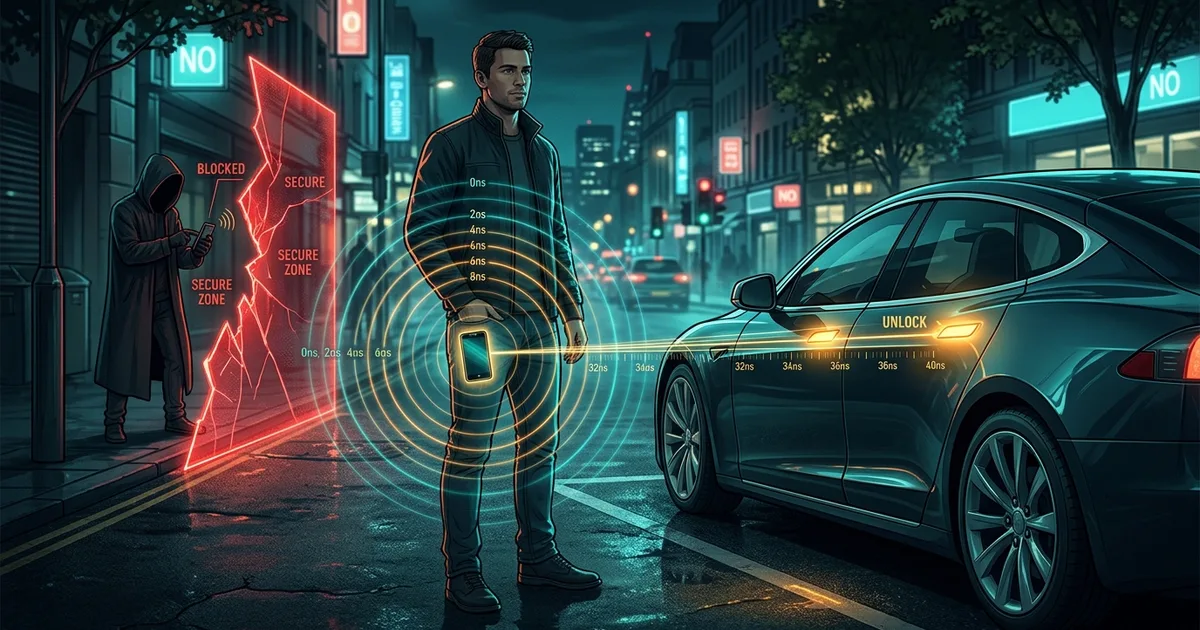
TL;DR (Direct Answer): Ultra-Wideband (UWB) is a short-range radio technology that lets phones measure the distance to another device to within about 10 centimeters. Bluetooth estimates distance from how strong a signal sounds. UWB times how long the signal takes to travel. That precision lets your phone unlock your car, guide you to a lost tag, and block the "relay attacks" thieves use to steal keyless cars.
Why Your Car Key Needed a Stopwatch
Imagine guessing how far away a friend is by how loudly they shout. A whisper might mean "far," or it might mean "close but shy." That is how Bluetooth judges distance: it reads signal strength, which walls, bodies, and pockets easily distort.
Now imagine you clap, time the echo, and calculate the exact distance. That is Ultra-Wideband. It is a stopwatch, not an ear.
This matters for three reasons. Keyless cars get stolen in seconds because they trust "loud enough" signals. Lost items are hard to find when your phone only says "nearby." And doors still need physical keys because nothing could reliably prove you were standing right there. UWB fixes all three.
How UWB Measures Distance
Tiny pulses, wide band
UWB sends extremely short radio pulses, each lasting about two billionths of a second. They are spread across a wide slice of spectrum, roughly 6.5 to 8 GHz. Think of it as a sharp click rather than a long hum. A sharp click is easy to time precisely.
Timing the round trip
Two devices exchange timestamped messages. This is called two-way ranging: your phone sends a message, the car replies, and both record exact times. The travel time is the time of flight. Light covers about 30 cm per nanosecond (one billionth of a second), so precise timing gives roughly 10 cm accuracy.
Direction and security
Phones with several UWB antennas compare when a pulse hits each one. This is angle of arrival, and it tells the phone which way to point. The IEEE 802.15.4z standard adds a secure layer. It uses a scrambled timestamp sequence, a secret pattern that changes constantly, so an attacker cannot predict or fake the replies.
UWB vs Bluetooth LE vs NFC vs Wi-Fi
Each wireless technology answers a different question. NFC asks "are you touching me?" Bluetooth Low Energy (BLE), the power-saving version of Bluetooth, asks "do you sound close?" UWB asks "exactly how far are you?"
| Technology | Accuracy | Range | Battery use | Relay attack resistance | Cost |
|---|---|---|---|---|---|
| NFC | Must touch | ~4 cm | Very low | Strong (needs contact) | Very low |
| Bluetooth LE | 1-5 m, rough guess | ~10-50 m | Very low | Weak | Very low |
| Wi-Fi positioning | 2-15 m | Building-wide | Medium | Weak | Uses existing routers |
| UWB | ~10 cm | ~10-50 m | Low, used in bursts | Strong (measures time) | Moderate |
UWB has downsides. Many phones still lack the chip. Range is short. Countries regulate these frequencies differently. Apple, Google, Samsung, and carmakers also run rival ecosystems that do not always work together. You can explore how signal timing turns into distance in our Interactive Engineering Simulations.
Your Phone as a Car Key
The digital key flow
The Car Connectivity Consortium's Digital Key 3.0 standard combines BLE and UWB. BLE is the doorbell, and UWB is the ruler.
CAR KEY (Digital Key 3.0)
  Phone  ~30 m  -->  BLE: "I'm here"     -> car wakes UWB radios
  Phone  ~10 m  -->  UWB ranging starts  -> distance: 6.2 m... 3.1 m...
  Phone  < 2 m  -->  doors unlock
  Phone INSIDE  -->  engine start allowed

LOST TAG (Precision Finding)
  [Phone]  --->  "Keys: 2.4 m  ↗ turn right"  --->  [Tag]
The diagram shows the car trusting your phone only as UWB confirms it getting closer, and how the same ranging drives an on-screen arrow to a lost tag.
The driveway theft
One night, a family's keyless SUV vanished from their driveway in under 60 seconds. One thief stood near the house with an amplifier that caught the key fob's signal. A partner by the car rebroadcast it. The car heard the fob "loud and clear" and opened. That is a relay attack: a signal passed along so the car believes the key is close.
With UWB, the relay adds extra nanoseconds of travel time. Even 10 nanoseconds of delay means meters of added distance. The car calculates "too far" and stays locked.
Hotels, offices, and smart locks are moving to phone-as-key too. Hands-free payments and indoor navigation in airports are next.
Common Myths About UWB
"UWB is just faster Bluetooth." Wrong. UWB is a ruler, not a data pipe. Its job is measuring distance, not streaming music.
"It tracks me everywhere." UWB works only over short distances. Apple and Google also send unknown-tracker alerts to warn you if someone's tag is traveling with you.
"Relay attacks are impossible now." They are much harder, not impossible. Security depends on carmakers enabling secure ranging and checking timing strictly.
"All new phones have it." Many mid-range and budget models skip the chip to save cost.
"It drains my battery." UWB fires in short bursts, usually after Bluetooth wakes it. The impact is small. Want more plain-English tech experiments? Visit our AI Playground.
Frequently Asked Questions (FAQ)
Does my phone support UWB, and how do I check?
Most iPhones from the iPhone 11 onward have UWB, except the iPhone SE models. On Android, Samsung's Plus and Ultra flagships and Google's Pixel Pro models usually include it. Check on Android under Settings, then Connections or Connected devices, and look for an "Ultra-Wideband (UWB)" toggle. On iPhone, Precision Finding for AirTags in the Find My app means you have it. Your phone's spec sheet will also list UWB if present.
Can UWB be hacked or relayed?
UWB is far harder to relay than Bluetooth because it measures signal travel time. A relay adds delay, and the delay reveals extra distance. The IEEE 802.15.4z standard also scrambles timestamps so attackers cannot predict replies. Still, no system is perfect. Researchers have found flaws in some early implementations. Real protection depends on the carmaker or lock maker turning on secure ranging and enforcing strict timing limits. Keep your phone and car software updated.
Is UWB harmful or high radiation?
No. UWB transmits at extremely low power, far below Wi-Fi and a phone's cellular radio. Regulators cap UWB emissions at levels so faint they sit close to background radio noise. It also transmits only in short bursts when ranging is needed. UWB uses non-ionizing radio waves, the same broad category as Wi-Fi and Bluetooth. There is no evidence that UWB at these power levels poses any health risk to people.
Does it work if my phone battery dies?
Often, yes, but through NFC rather than UWB. Many phones keep a small power reserve after shutting down. On iPhone, car keys in Express Mode can still work by tapping the phone on the door handle for several hours after the battery dies. Some Android phones offer similar features. You lose hands-free walk-up unlocking, though, because UWB needs power. Check your carmaker's app for exact backup options.
Will UWB replace NFC for payments and door access?
Probably not fully. The two will likely work as a team. NFC is cheap, already in billions of cards and terminals, and the deliberate tap gives a clear sign of consent, which suits payments. UWB shines where hands-free convenience matters, like cars, office doors, and smart home locks. Some companies are testing UWB for walk-through payments. Expect UWB for "walk up" moments and NFC for "tap to confirm" moments.